
What’s Known
Amniocentesis is an invasive procedure for detecting Trisomy 21 (Down syndrome). However, its associated complications are amniotic fluid leakage, preterm premature rupture of membrane, fetal needle injury, and amniotic fluid culture failure. Therefore, non-invasive procedures—namely, serum biochemical marker screening—are prioritized.
What’s New
A pregnancy-associated plasma protein-A level of <0.42 multiples of the median and a beta-human chorionic gonadotropin level of ≥1.52 multiples of the median could acceptably predict Down syndrome in cases with abnormal amniocentesis results. It is recommended that pregnancies with a Down syndrome risk of up to 1:100 undergo amniocentesis directly, while those with a risk greater than 1:100 should be offered non-invasive alternatives.
Introduction
Congenital anomalies (CAs) are defined as structural, functional, or metabolic abnormalities that originate during intrauterine life and can disrupt body function, with a prevalence of 3% nationwide and 2.3% in Iran. 1 CAs can result from single-gene, chromosomal, or hereditary disorders, environmental factors, or specific nutritional deficiencies. 2 They are among the most common causes of miscarriage, prenatal death, and neurodevelopmental disorders. Approximately 90% of CAs involve numerical chromosomal disorders, including 13, 16, 18, 21, and 22. 3 Trisomy 21 (Down syndrome) is strongly associated with advanced maternal age and increased fetal nuchal translucency (NT), yet it remains diagnostically challenging in up to 50% of cases. 4
In recent years, significant efforts have been made to improve the prenatal diagnosis of Down syndrome. 5 One common stratification based on the first-trimester screening places mothers into three risk groups. The high-risk group, identified by serum biochemical markers and ultrasound measurement of NT, is recommended to undergo invasive diagnostic testing such as amniocentesis or chorionic villus sampling with fetal karyotyping or rapid molecular testing. The moderate-risk group should receive second-trimester follow-up testing, while the low-risk group requires no further intervention. 6 , 7
Amniocentesis is an invasive diagnostic procedure for the detection of CAs. The procedure is performed in a sterile outpatient setting under ultrasound control. A needle is inserted through the maternal abdomen into the uterine cavity to take amniotic fluid containing fetal cells, which can be used for chromosomal, biochemical, or molecular analysis. The procedure may cause sensitivity in mothers with a negative Rhesus factor. The increased risk of miscarriage following amniocentesis is approximately 0.5% above the background rate. Potential complications include amniotic fluid leakage, the preterm premature rupture of membranes, fetal needle injury (if not performed under direct sonographic guidance), and amniotic fluid culture failure. 8
Consequently, non-invasive procedures, including non-invasive prenatal test (NIPT), prenatal ultrasound, and serum biochemical markers (which utilize fetal cells or cell-free fetal DNA that have entered the maternal circulation via the placenta), are increasingly prioritized. 5
According to the “National Guidelines for the Organizational Program for the Prevention of Fetal Chromosomal Abnormalities: Down Syndrome and Trisomy 13 and 18,” a positive screening result with a Down syndrome risk ≥1:250 warrants further action: if the calculated risk is ≥1:10, direct referral for amniocentesis is indicated; if the risk is between 1:10 and 1:250, complementary NIPT is recommended; with amniocentesis advised if NIPT is positive.
Maternal serum biochemical markers, such as pregnancy-associated plasma protein-A (PAPP-A) below the fifth percentile and beta-human chorionic gonadotropins (β-hCG) above the 95th percentile in the first trimester, are established non-invasive methods for detecting Down syndrome. 4 This study aimed to investigate the association between serum biochemical markers (PAPP-A and β-hCG levels) and amniocentesis results in diagnosing Down syndrome among the first-trimester pregnant women in southern Iran, 2021-2022.
Materials and Methods
Study Population and Setting
In this cross-sectional study, data were extracted from the medical records of pregnant women at 11-13+6 weeks of gestation who were referred for amniocentesis for fetal genetic diagnosis to the Comprehensive Genetics Center of Southern Iran (Shiraz, Iran) during 2021-2022. The inclusion criteria were a crown-ramp length (CRL) between 45 and 84 mm and a gestational age of 11-13+6 weeks. Pregnant women with incomplete information in their clinical records were excluded from the study.
Study Variables and Measurements
Data were collected using a checklist that included maternal weight (Kg), gestational age at the NT scan (weeks), NT thickness (mm), nasal bone (NB) status (present/absent), PAPP-A level in multiples of median (MoM), and β-hCG level in MoM.
PAPP-A and β-hCG were measured from venous blood samples using commercial assays (DPC-USA) based on an immuno-chemiluminescence technique and analyzed on an automated Immulite 2000 analyzer (Diagnostic Products Corporation, United States of America).
The NT and NB were measured by color Doppler ultrasound using a high-resolution ultrasound device with a cine loop function for replay and a caliper providing measurements in decimal form. Scans were limited to the fetal head and upper chest at maximal magnification, where minimal caliper movement adjusted measurements by 0.1 mm. The NT was measured with the fetus in a neutral position, as the maximum thickness of the subcutaneous translucency between the skin and soft tissue overlying the cervical spine. 9 All ultrasound examinations were performed using an Aloka Prosound 3500 system (Akola Co., Ltd., Japan) at the Comprehensive Genetics Center of Southern Iran, Shiraz.
Sample Size Considerations
All eligible cases meeting the inclusion criteria were enrolled. The unequal group sizes reflect the natural prevalence of the outcome within the sampling population.
Chromosomal Identification of Down SyndromeA Down syndrome risk of ≥1:250 was considered a positive screening result, based on fetal crown-rump length, NT/NB, and maternal PAPP-A and β-hCG levels.
Ethical Considerations
This study was conducted in accordance with the ethical principles of the Declaration of Helsinki. The study protocol was reviewed and approved by the Ethics Committee of Shiraz University of Medical Sciences, Shiraz, Iran (code: IR.SUMS.MED.REC.1402.066). Written informed consent was obtained from all participants.
Statistical Analysis
Quantitative variables were described using median (interquartile range, IQR) or mean±SD, as appropriate. Qualitative variables were described using frequency (relative frequency). The Kolmogorov-Smirnov test, Mann-Whitney U test, Chi square test, Fisher’s exact test, and logistic regression were used for data analysis. Crude and adjusted odds ratios with 95% confidence intervals (ORcrude, 95% CI, and ORadj, 95% CI) were reported. 10
Receiver operating characteristic (ROC) analysis was applied to determine optimal cut-off values using the Youden index(J=sensitivity+specificity-1). 10 , 11 Sensitivity and specificity were reported for these cut-offs. The Hanley and McNeil method was used to compare ROC curves. Area under ROC (AUR) values were interpreted as follows: 0.7-0.8, acceptable; 0.8-0.9, excellent; >0.9, outstanding. 12 , 13
Cut-off values were estimated separately for two cohorts: 1) the total cohort, comprising all patients who underwent amniocentesis, and 2) the abnormal cohort, comprising only patients with a confirmed abnormal karyotype (Down syndrome).
This approach addresses distinct clinical questions regarding general screening performance and marker distribution within the disease-positive group.
Analyses were performed using IBM SPSS software (version 22, IBM Corporation, USA) with statistical significance set at P<0.05. A post hoc power analysis was conducted using G*Power 3.1.9.2 (Germany) to examine the study’s ability to detect an existing effect.
Results
The indications for the amniocentesis test among the 1,987 cases, stratified by the result, are shown in table 1.
| Amniocentesis cause | Amniocentesis result | ||
|---|---|---|---|
| Abnormal, n=69 | Normal, n=1,918 | Total, n=1,987 | |
| Diagnosing test for high-risk Down syndrome, n (%) | 49 (72.1) | 1,624 (86) | 1,673 (85.5) |
| Diagnosing test for high-risk trisomy 13&18, n (%) | 7 (10.3) | 7 (10.3) | 7 (10.3) |
| Mother requestsa, n (%) | 1 (1.5) | 1 (1.5) | 1 (1.5) |
| Abnormality of either PAPP-A or β-hCG biochemical markersb, n (%) | 5 (7.4) | 5 (7.4) | 5 (7.4) |
| Absent nasal bone, n (%) | 1 (1.5) | 1 (1.5) | 1 (1.5) |
| High nuchal translucency, n (%) | 4 (5.9) | 4 (5.9) | 4 (5.9) |
| Positive non-invasive prenatal testing, n (%) | 1 (1.5) | 1 (1.5) | 1 (1.5) |
| PAPPA: Pregnancy-associated plasma protein-A; β-hCG: Beta-human chorionic gonadotropins; aRequest due to a history of Down syndrome in previous births; a history of Down syndrome in parents’ first-class family; or maternal age over 45 years; bLow PAPP-A or high β-hCG levels but no risk of Down syndrome | |||
The most common indication was Down syndrome screening, accounting for 1,673/1,987 (85.5%) of all cases and 49/69 (72.1%) of cases in the abnormal amniocentesis group.
Of the 1,987 amniocentesis cases, 96.5% (1,918/1,987) had a normal result and 3.5% (69/1,987) had an abnormal result. Down syndrome was diagnosed in approximately 3% (49/1,987) of cases. Maternal weight and gestational age at NT scan were compared between the groups, as displayed in table 2.
| Variable | Total n=1,987 | Normal amniocentesis n=1,918 | Abnormal amniocentesis n=69 | P value |
|---|---|---|---|---|
| Maternal weight (Kg, median [IQR]) | 68 (5) | 68 (15) | 64 (15.75) | 0.04* |
| Gestational age at NT scan (week, median [IQR]) | 35 (8.30) | 12 (1) | 13 (1) | 0.64* |
| *Mann-Whitney U test; NT: Nuchal translucency; IQR: Interquartile range; NOTE: Mann-Whitney U test does not rely on the assumption of equal variances/unequal sample size, ensuring the validity of P value; P<0.05 was considered statistically significant. | ||||
Maternal weight was significantly lower in the abnormal amniocentesis group than the normal amniocentesis group (P=0.04). Gestational age at the NT scan did not differ significantly between the groups.
The association between maternal age, PAPP-A, β-hCG, NB, and NT status, and specific Down syndrome risk thresholds (1:10, 1:50, 1:100, 1:200, and 1:250) with amniocentesis outcome is shown in table 3.
| Variable | Normal amniocentesis n=1,918 | Abnormal amniocentesis n=69 | ORc (95% CI) | P value** | ORadj (95% CI)* | P value** | |
|---|---|---|---|---|---|---|---|
| Maternal age (year, median [IQR]) | 35.30 (8.30) | 37.30 (8.35) | 1.08 (1.03-1.13) | 0.01 | 1.09 (1.04-1.14) | <0.001 | |
| Nuchal translucency (mm, median [IQR]) | 1.38 (0.43) | 1.53 (0.81) | 2.28 (1.61-3.23) | <0.001 | 2.22 (1.56-3.16) | <0.001 | |
| Nasal bone, n (%) | Present | 1,570 (82.90) | 54 (81.8) | 1.08 (0.57-2.04) | 0.82 | 1.06 (0.56-2.02) | 0.84 |
| Absent | 324 (17.1) | 12 (18.2) | |||||
| PAPP-A (MoM), median (IQR) | 0.68 (0.60) | 0.53 (0.59) | 0.6 (0.35-1.03) | 0.06 | 0.57 (0.34-0.98) | 0.03 | |
| β-hCG (MoM), mean±SD | 1.79 (1.81) | 2.32 (3.55) | 1.07 (0.98-1.16) | 0.12 | 1.21 (1.02-1.26) | 0.04 | |
| Down syndrome risk, n (%) | ≤1:10 (ref cat) | 1,823 (95) | 50 (72.5) | 7.29 (4.14-12.86) | <0.001 | 2.23 (1.12-4.47) | 0.02 |
| >1:10 | 95 (5) | 19 (27.5) | |||||
| Down syndrome risk, n (%) | ≤1:50 (ref cat) | 1,517 (79.10) | 41 (59.40) | 2.58 (1.58-4.23) | <0.001 | 4.93 (3.06-7.95) | <0.001 |
| >1:50 | 401 (20.90) | 28 (40.60) | |||||
| Down syndrome risk, n (%) | ≤1:100 (ref cat) | 1,196 (62.40) | 28 (40.60) | 2.43 (1.49-3.96) | <0.001 | 8.16 (5.34-12.26) | <0.001 |
| >1:100 | 722 (37.60) | 41 (59.4) | |||||
| Down syndrome risk, n (%) | ≤1:200 (ref cat) | 733 (38.20) | 13 (18.80) | 2.66 (1.45-4.91) | 0.002 | 5.95 (4.53-7.80) | <0.001 |
| >1:200 | 1,185 (61.80) | 56 (81.20) | |||||
| Down syndrome risk, n (%) | ≤1:250 (ref cat) | 1,624 (84.70) | 49 (71) | 2.25 (1.32-3.85) | 0.003 | 2.17 (1.27-3.72) | 0.005 |
| >1:250 | 294 (15.30) | 20 (29) | |||||
| ORc: Crude odds ratio; ORadj: Adjusted odds ratio; *Adjusted on maternal weight; MoM: Multiple of median; PAPP-A: Pregnancy-associated plasma protein-A; β-hCG: Beta-human chorionic gonadotropins; SD: Standard deviation. NOTE: Excessively large coefficient estimates were not seen (|βs|4; min and max (ORs) are 0.57 and 8.16 with related regression coefficients of -0.56 and 2.1, respectively; |-0.56|>! 4 and |2.1|>! 4; in addition, all standard deviations were much smaller than their related coefficients, justifying P validity; >! defines not greater than; The unequal sample sizes in our study reflect the natural prevalence of the outcome in our population/sampling frame; **Logistic regression model; P<0.05 was considered statistically significant. | |||||||
Compared to the normal amniocentesis group, PAPP-A levels were significantly lower in the abnormal amniocentesis group, while maternal age, NT status, and β-hCG were significantly higher. An adjusted odds ratio of 0.55 for PAPP-A indicated that the odds of a lower PAPP-A level were 0.55 times lower in the abnormal group. In addition, the odds ratio of 1.21 indicated that the odds of β-hCG were 1.21 times higher among abnormal amniocentesis patients than normal amniocentesis patients. In addition, NB status did not differ between the groups. The risks for Down syndrome at thresholds of 1:10, 1:50, 1:100, 1:200, and 1:250 were all significantly higher in the abnormal amniocentesis group than the normal amniocentesis group (ORadj=2.23, 4.93, 8.16, 5.95, and 2.17, respectively).
When controlling for maternal weight, the multiple logistic regression provided a more precise estimate of the associations. For β-hCG, the effect size increased from a non-significant 7% increase in risk in the univariate model (OR=1.07, 95% CI: 0.98–1.16; P=0.12) to a significant 21% increase in the adjusted model (OR=1.21, 95% CI: 1.02–1.26; P=0.04). From a clinical perspective, even a 21% increase in risk could be meaningful at the population level. This adjustment also addresses the statistical validity of the model, given the unequal group sizes.
Receiver operating characteristic (ROC) analysis results, providing optimal cut-off values for NT, maternal age, PAPP-A, and β-hCG for diagnosing Down syndrome in the total cohort and in the abnormal karyotype subgroup, are shown in table 4 and figure 1.
| Amniocentesis | Variable | Cut-off point | Youden index | Sensitivity (%) | Specificity (%) | AURa | P value | |
|---|---|---|---|---|---|---|---|---|
| Total n=1,987 | Age (year) | >31.40 | 0.15 | 75 | 41 | 0.54 | 0.02 | |
| Nuchal Translucency (mm) | ≥1.95 | 0.09 | 91 | 19 | 0.52 | 0.30 | ||
| Down syndrome risk 1:10 | PAPP-A, (MoM) | <0.46 | 0.28 | 74 | 56 | 0.67 | <0.001 | |
| β-hCG, (MoM) | ≥1.67 | 0.29 | 48 | 82 | 0.67 | <0.001 | ||
| Down syndrome risk 1:50 | PAPP-A, (MoM) | <0.73 | 0.22 | 45 | 73 | 0.63 | <0.001 | |
| β-hCG, (MoM) | ≥1.73 | 0.26 | 54 | 73 | 0.67 | <0.001 | ||
| Down syndrome risk 1:100 | PAPP-A, (MoM) | <0.81 | 0.20 | 46 | 74 | 0.62 | <0.001 | |
| β-hCG, (MoM) | ≥1.39 | 0.25 | 45 | 79 | 0.67 | <0.001 | ||
| Down syndrome risk 1:200 | PAPP-A, (MoM) | <0.77 | 0.17 | 52 | 65 | 0.56 | <0.001 | |
| β-hCG, (MoM) | ≥1.16 | 0.37 | 51 | 86 | 0.73 | <0.001 | ||
| Down syndrome risk 1:250 | PAPP-A, (MoM) | <0.27 | 0.14 | 92 | 23 | 0.51 | 0.67 | |
| β-hCG, (MoM) | ≥1.16 | 0.39 | 79 | 62 | 0.73 | <0.001 | ||
| Abnormal, n=69 | Age (year) | >35.8 | 0.39 | 73 | 65 | 0.60 | 0.23 | |
| Nuchal Translucency (mm) | ≥1.27 | 0.15 | 30 | 85 | 0.56 | 0.41 | ||
| Down syndrome risk 1:10 | PAPP-A, (MoM) | <0.59 | 0.40 | 56 | 84 | 0.68 | 0.008 | |
| β-hCG, (MoM) | ≥1.2 | 0.31 | 36 | 95 | 0.66 | 0.01 | ||
| Down syndrome risk 1:50 | PAPP-A, (MoM) | <0.59 | 0.33 | 59 | 75 | 0.67 | 0.01 | |
| β-hCG, (MoM) | ≥1.66 | 0.29 | 52 | 79 | 0.69 | 0.002 | ||
| Down syndrome risk 1:100 | PAPP-A, (MoM) | <0.59 | 0.26 | 61 | 66 | 0.61 | 0.11 | |
| β-hCG, (MoM) | ≥0.71 | 0.28 | 29 | 100 | 0.66 | 0.01 | ||
| Down syndrome risk 1:200 | PAPP-A, (MoM) | <0.5 | 0.43 | 85 | 59 | 0.71 | 0.02 | |
| β-hCG, (MoM) | ≥0.91 | 0.62 | 70 | 92 | 0.87 | <0.001 | ||
| Down syndrome risk 1:250 | PAPP-A, (MoM) | <0.42 | 0.58 | 90 | 68 | 0.75 | 0.003 | |
| β-hCG, (MoM) | ≥1.52 | 0.45 | 76 | 70 | 0.75 | 0.0003 | ||
| AUR: Area under roc; CI: Confidence interval; aHanley & McNeil; PAPP-A: Pregnancy-associated plasma protein-A; β-hCG: Beta-human chorionic gonadotropins; MoM: Multiple of median; note: cut-off points, Youden index, AUR, sensitivity, and specificity are estimated regarding multiple associations; The ‘Total’ cohort includes all patients undergoing amniocentesis. The ‘Abnormal’ cohort includes only patients with a confirmed abnormal karyotype (Down syndrome). Cut-offs were derived separately as they address different clinical questions: screening performance in a mixed population vs. marker distribution in the disease-positive group. | ||||||||
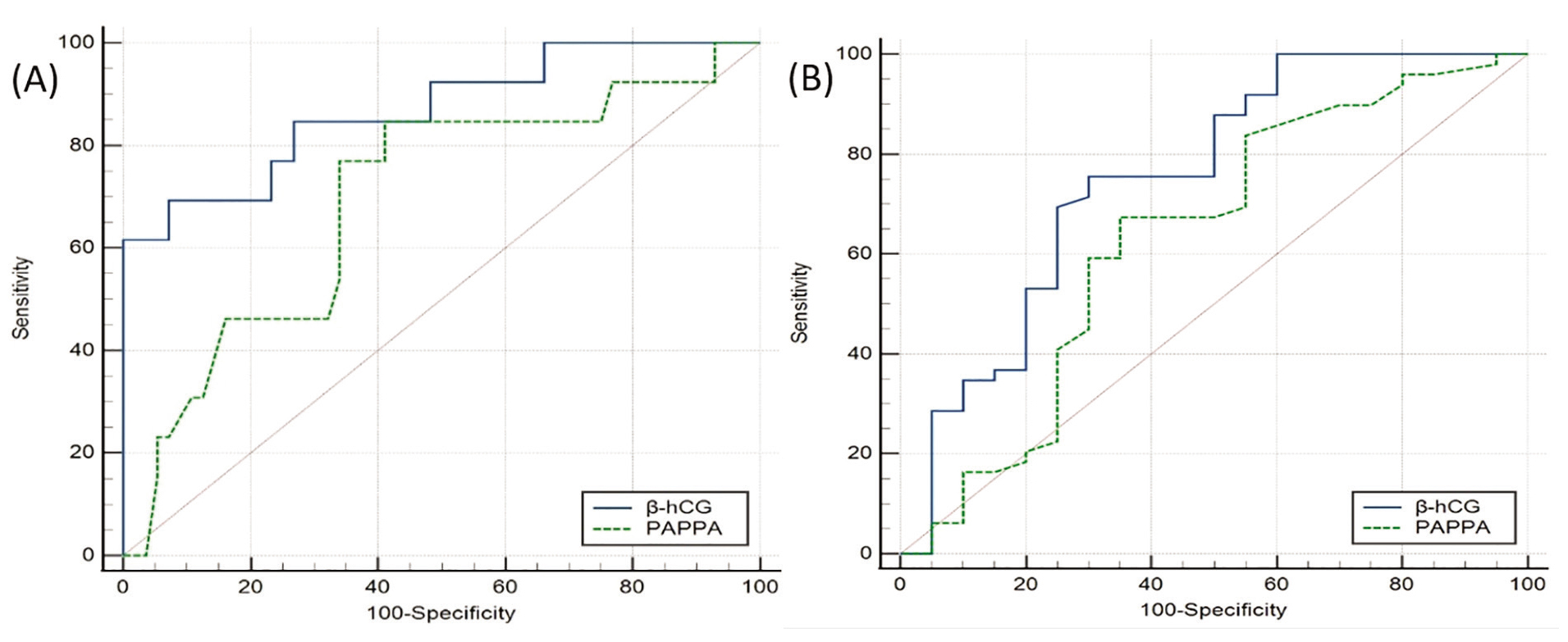
Figure 1. Receiver operating characteristic (ROC) curves compare pregnancy-associated plasma protein-A (PAPP-A) and beta-human chorionic gonadotropins (β-hCG) diagnosing Down syndrome risk thresholds of 1:200 (A), and Down syndrome risk thresholds of 1:250 (B) in abnormal amniocentesis cases.
Among the 1,987 amniocentesis cases, a β-hCG level of ≥1.16 MoM acceptably predicted both a Down syndrome risk of ≥1:200 and a risk of ≥1:250. Maternal age and NT were not accurate predictors in this cohort (AUR=0.54 and 0.52, respectively).
Within the 69 abnormal amniocentesis cases, β-hCG level of ≥1.52 MoM and PAPP-A level of <0.42 MoM acceptably predicted a Down syndrome risk of ≥1:250 (AUR=0.75 for both). In addition, a β-hCG level of ≥0.91 MoM excellently predicted a Down syndrome risk of ≥1:200 (AUR=0.87), while a PAPP-A level of <0.5 MoM acceptably predicted the same risk threshold (AUR=0.71). Neither maternal age nor NT status had predictive value for Down syndrome in this group (AUR=0.60 and 0.56, respectively).
Comparisons of the ROC curves for β-hCG and PAPP-A in diagnosing Down syndrome risk thresholds of ≥1:200 and ≥1:250 among the 69 abnormal amniocentesis cases are shown in table 5 and figure 1.
| Down syndrome risk | AUR curve comparisons | |||
|---|---|---|---|---|
| PAPP-A~ β-hCG | ||||
| Difference between areas | Standard errora | 95% (CI) | P value* | |
| 1:200 | 0.17 | 0.08 | 0.2-0.33 | 0.03 |
| 1:250 | 0.12 | 0.09 | -0.05-0.30 | 0.19 |
| AUR: Area under roc; CI: Confidence interval; aHanley & McNeil; PAPP-A: Pregnancy-associated plasma protein-A; β-hCG: Beta-human chorionic gonadotropins; The results of the P value from a test of the difference between the AUR curves of PAPP-A and β-hCG; A significant P value (P<0.05) indicates a statistically significant difference in the diagnostic performance of the two biomarkers for that specific risk threshold; *Hanley and McNeil test | ||||
ROC curve comparison showed no significant difference between β-hCG and PAPP-A in diagnosing a Down syndrome risk of ≥1:250 in abnormal amniocentesis cases (P=0.19). However, β-hCG was superior to PAPP-A in diagnosing a risk of ≥1:200 (P=0.03).
Of the 49 Down syndrome cases identified based on a risk threshold of ≥1:250, 75.5 % (37/49) and 49% (24/49) fell within the higher risk categories of ≥1:100 and 1:50, respectively (P<0.001 and P=0.02, respectively). In contrast, only 30.65% (15/49) were at risk of ≥1:10 (P=0.51). All cases (100%, 49/49) were at risk of ≥1:200 (P<0.001).
Power Analysis Result
The estimated sensitivity and specificity for PAPP-A and β-hCG, along with their corresponding statistical power, are presented in table 6.
| Test | Cut-off | Metric | Point estimate (95% CI) |
|---|---|---|---|
| PAPP-A | <0.42 MoM | Sensitivity | 90% (82%-97.60%) |
| Specificity | 68% (65.90%-70.10%) | ||
| β-hCG | ≥1.52 MoM | Sensitivity | 76% (64.90%-86.80%) |
| Specificity | 70% (68%-72%) | ||
| MoM: Multiple of median; PAPP-A: Pregnancy-associated plasma protein-A; β-hCG: Beta-human chorionic gonadotropins; The ‘Point Estimate’ represents the observed sensitivity and specificity of each biomarker at the specified cut-off value within our study cohort. The accompanying 95% confidence interval quantifies the precision of this estimate, indicating the range within which the true population value is likely to lie. | |||
The specificity for both tests was estimated with very high precision, as indicated by narrow confidence intervals spanning approximately four percentage points. This precision is attributable to the large sample size of normal cases (n=1,927), allowing high confidence that the true specificity lies close to the observed range of 68-70%. In contrast, the sensitivity for both tests was estimated with lower precision due to the smaller number of Down syndrome cases (n=60). Consequently, the true sensitivity for the PAPP-A test could realistically range from 82%to 98%, and for the β-hCG test, from 65% to 87%.
The β-hCG test’s true sensitivity could be as low as 65% or as high as 87%.
Discussion
This study analyzed data from 1,987 first-trimester amniocentesis performed for the diagnosis of chromosomal anomalies, primarily Down syndrome. The results showed that 3.5% of cases were abnormal, with Down syndrome accounting for approximately 3% of the total. Maternal weight was significantly lower in the abnormal group. After adjusting for maternal weight, maternal age, NT, and β-hCG were significantly higher, while PAPP-A was significantly lower in abnormal cases; NB status showed no significant difference. The findings indicated that neither NT nor maternal age alone provided significant diagnostic value. However, β-hCG and PAPP-A were strong predictors for Down syndrome risks of 1:200 and 1:250. Specifically, a PAPP-A level of <0.42 MoM and a β-hCG level of ≥1.52 MoM could independently and acceptably predict a Down syndrome risk of ≥1:250 in abnormal amniocentesis cases.
Based on these results, we recommend direct referral for amniocentesis test for pregnancies with a Down syndrome risk of up to 1:100. For those with a risk greater than 1:100, non-invasive alternatives such as NIPT should be offered. This approach advocates for a future clinical pathway in which non-invasive methods help minimize the need for invasive diagnostic procedures.
In line with the current study, the most common indication for amniocentesis test in early pregnancy is a high risk for Down syndrome. 9 , 14 , 15 In a cross-sectional study on the result of chromosomal cultures from 762 high-risk pregnancies, women combined with a diagnosing test, the risk of Down syndrome was estimated at 3.8%, which was slightly more than the 3% found in the present study. 16 Maternal weight was shown to significantly impact first-trimester Down syndrome risk assessment. 17 Accordingly, we controlled for maternal weight in our analysis to avoid discrepancies in the results.
In a study evaluating the indications for genetic amniocentesis in Poland, a positive correlation was reported with maternal age, using a threshold of 35 years. 2 Similarly, our study found a positive association, with median maternal ages of 37.50 and 35.30 years in abnormal and normal amniocentesis groups, respectively. However, no precise maternal age threshold, as a standalone predictor, was estimated in the present study due to the non-significance of AUR. This suggested that while advanced maternal age is a common risk factor, a universally applicable cutoff point may vary across populations, and its optimal use requires integration with other risk factors. Nevertheless, supporting our observation, other studies also reported a significantly higher rate of amniocentesis among women over 35 years old than among younger women. 1 , 16
PAPP-A and β-hCG were reported as independent markers for Down syndrome, which showed no direct association with NT. Researchers in these studies concluded that integrating biochemical and ultrasound findings is necessary for effective diagnosis. 1 , 18 , 19 In contrast to our findings, other studies reported that NT, PAPP-A, and β-hCG might not be sufficiently accurate for diagnosing Down syndrome. 20 , 21 This discrepancy likely arises because those studies evaluated these markers as standalone diagnostic tests, for which they are inherently unsuited. No single biochemical or sonographic marker is definitively diagnostic; their true strength lies in their synergistic use to calculate a composite risk, which then identifies a high-risk population requiring definitive diagnostic testing via amniocentesis. Therefore, the criticism of their standalone accuracy is valid but does not invalidate their well-established role in effective population-based screening.
A systematic review and meta-analysis reported low sensitivity for NB in detecting Down syndrome, 22 a finding consistent with our study, which also found no significant association. However, another study noted that while the absence of NB could serve as a marker in early pregnancy, its combination with NT, PAPP-A, and β-hCG could yield a high detection rate with a low false-positive rate. 23 Similarly, another study concluded that the presence of NB might reduce the need for invasive testing, while its absence indicated a positive likelihood ratio for Down syndrome. 24 Thus, while the NB is a poor standalone predictor, its clinical value is realized when integrated into a multi-parameter screening panel. These findings underscore that NB holds significant associative value within a combined risk assessment model.
PAPP-A levels were shown to decrease in pregnancies with Down syndrome compared to unaffected pregnancies, with a reported median of 0.51 MoM, which was similar to our finding of 0.53 MoM. 16 , 25 This supports the role of reduced PAPP-A as a significant marker for detection. In the present study, a positive association was observed between abnormal amniocentesis and PAPP-A levels, with an odds ratio of 2.17, underscoring the importance of diagnostic testing in high-risk pregnancies.
Discrepancies exist in reported cut-offs for β-hCG when evaluating its levels in Down syndrome versus unaffected pregnancies. Hsu and others reported a significant increase in β-hCG in Down syndrome pregnancies (median of β-hCG=2.56 MoM) compared to unaffected ones. 26 However, Mirsafaei and colleagues found no statistically significant difference, despite reporting a similar median elevation of 2.50 MoM. 16 This disagreement probably did not reflect a difference in the observed effect size, as both studies reported comparable elevations (~2.5 MoM). Instead, it could arise from differences in the precision and reliability of those estimates, influenced by factors such as sample size, population characteristics, and statistical methods. In such instances, the study with a larger sample size and more rigorous controls is generally considered more authoritative.
β-hCG has been established as a reliable marker for detecting Down syndrome in general screening populations. In the present study, which focused on an early amniocentesis population, elevated β-hCG was associated with an increased risk of Down syndrome (OR=1.21). This finding was in agreement with findings by Ziolkowska and others, who reported a β-hCG threshold of 1.5 MoM for Down syndrome 18 —a value consistent with our cut-off of ≥1.52 MoM. Another study also found a significant association between β-hCG≥1.5 MoM and Down syndrome. 16 Therefore, by applying an accurate β-hCG threshold, Down syndrome could be effectively detected using a dual-marker approach with PAPP-A and β-hCG in our population.
Three previous studies have found significant associations between NT values and Down syndrome, with median NT values of 1.03, 2.67, and 2.02 mm, respectively. 16 , 18 , 27 A similar association was observed in the present work (median NT=1.53 mm). Consequently, an NT threshold of 1.53 mm might be appropriate for risk assessment in this population. Additionally, in the present study, chromosomal microdeletions were not identifiable in samples with NT ≥3.5 MoM. It is therefore recommended that specific testing for microdeletion syndromes be considered in cases with NT ≥3.5 MoM. 28
In a study evaluating the biochemical markers PAPP-A and β-hCG, along with NT, in early amniocentesis for Down syndrome among 251 high-risk pregnancies (risk >1:300), Down syndrome was present in 13% of cases. 18 That study reported significantly elevated β-hCG (≥1.5 MoM) and significantly decreased PAPP-A (<0.5 MoM) levels, while NT showed no diagnostic value, 18 which were consistent with the findings of the present study. In another study, the same results of β-hCG≥1.50 MoM and PAPP-A≤0.5 MoM, with no diagnostic value for NT, were reported. 16 All the mentioned findings were in agreement with the findings of the present study.
A key limitation of this study was the high ratio of controls to cases. Although this design enhanced statistical efficiency and the ability to detect small effect sizes, it might create an analytical imbalance that may inflate the precision of estimates (e.g., odds ratios) and increase susceptibility to selection bias. To minimize the selection bias, the control group was carefully selected to be representative of the source population.
Among the study’s strengths are its clear-cut definition of the study population from southern Iran, systematic data collection, and adjustment for relevant confounders, all of which served to reduce bias and enhance the comparability of the study groups. This study provided precise estimates for the non-invasive biochemical markers of PAPP-A and β-hCG in abnormal amniocentesis cases and proposes a clinically relevant Down syndrome risk threshold up to 1:100 for direct amniocentesis referral in this population.
Other limitations should be noted. Chromosomal microdeletions were not assessed in samples with NT ≥3.5 MoM; future studies should include specific testing for microdeletion syndromes in such cases. Furthermore, the retrospective design introduces the potential for missing data. To achieve more robust and generalizable results, future investigations should be multicenter to enroll a larger number of cases, particularly to obtain a more precise estimate of the sensitivity of these biomarkers. A dedicated validation study with a larger Down syndrome cohort is therefore recommended.
Conclusion
This study analyzed data from 1,987 first-trimester amniocentesis performed for the diagnosis of chromosomal anomalies, primarily Down syndrome. Results indicated that 3.5% of cases yielded abnormal results, with Down syndrome accounting for approximately 3% of the total. Maternal weight was significantly lower in the abnormal group. After adjusting for maternal weight, maternal age, NT, and β-hCG were significantly higher, while PAPP-A was significantly lower in abnormal cases, and NB status showed no significant difference.
The findings indicated that neither NT nor maternal age alone provided diagnostic value. However, β-hCG and PAPP-A were strong predictors for Down syndrome risk thresholds of 1:200 and 1:250. Specifically, a PAPP-A level of <0.42 MoM and a β-hCG level of ≥1.52 MoM independently and acceptably predicted Down syndrome risk of ≥1:250 among abnormal amniocentesis cases.
Based on these results, we recommend direct referral for amniocentesis for pregnancies with a Down syndrome risk of up to 1:100. For those with a risk greater than 1:100, non-invasive alternatives such as NIPT should be offered. This approach supports a future clinical pathway in which non-invasive methods help minimize the need for invasive diagnostic procedures.
Acknowledgment
This work was derived from the perinatal medicine fellowship thesis of Dr. Marzie Zare, which was funded by the Research and Technology Deputy of Shiraz University of Medical Sciences (grant no. 26851).
Authors’ Contribution
A.F, M.Z, and Mj.Z contributed to the conception, design, data acquisition, analysis, and interpretation of data for the work; they also drafted the work and revised it critically for important intellectual content; M.K, M.D, H.V, and N.A contributed to the conception of the work; they also drafted the work and revised it critically for important intellectual content; Kh.B contributed to the data acquisition and reviewed the manuscript. All authors have read and approved the final manuscript and agree to be accountable for all aspects of the work in ensuring that questions related to the accuracy or integrity of any part of the work are appropriately investigated and resolved.
AI Declaration
The authors declare that they have not used any AI tools or technologies to prepare this manuscript.
Conflict of Interest
None declared.
References
- Shiefa S, Amargandhi M, Bhupendra J, Moulali S, Kristine T. First Trimester Maternal Serum Screening Using Biochemical Markers PAPP-A and Free beta-hCG for Down Syndrome, Patau Syndrome and Edward Syndrome. Indian J Clin Biochem. 2013; 28:3-12. Publisher Full Text | DOI | PubMed [ PMC Free Article ]
- Sadlecki P, Walentowicz-Sadlecka M, Pasinska M, Adamczak R, Grabiec M. [Indications for genetic amniocentesis investigated at the Department of Gynecology, Obstetrics, and Oncologic Gynecology, Nicolaus Copernicus University, Collegium Medicum, Bydgoszcz]. Ginekol Pol. 2014; 85:420-3. PubMed
- Dey M, Sharma S, Aggarwal S. Prenatal screening methods for aneuploidies. N Am J Med Sci. 2013; 5:182-90. Publisher Full Text | DOI | PubMed [ PMC Free Article ]
- Smith GC, Stenhouse EJ, Crossley JA, Aitken DA, Cameron AD, Connor JM. Early pregnancy levels of pregnancy-associated plasma protein a and the risk of intrauterine growth restriction, premature birth, preeclampsia, and stillbirth. J Clin Endocrinol Metab. 2002; 87:1762-7. DOI | PubMed
- Carbone L, Cariati F, Sarno L, Conforti A, Bagnulo F, Strina I, et al. Non-Invasive Prenatal Testing: Current Perspectives and Future Challenges. Genes (Basel).. 2020; 12Publisher Full Text | DOI | PubMed [ PMC Free Article ]
- Cunningham FG, Leveno KJ, Bloom SL, Spong CY, Dashe JS, Hoffman BL, et al. Williams obstetrics. New York: McGraw-Hill Education; 2014.
- Vafaei H, Hadipour N, Kasraeian M, Yoosefi S, Alamdarloo SM, Asadi N, et al. Accuracy of prenatal ultrasonography for diagnosis of placenta accreta spectrum and risk factors in a tertiary center in southern Iran: one-year placenta accreta in Iran. Galen Med J. 2024; 13:e3316. DOI
- American College of O, Gynecologists. ACOG Practice Bulletin No. 88, December 2007. Invasive prenatal testing for aneuploidy. Obstet Gynecol. 2007; 110:1459-67. DOI | PubMed
- Loncar D, Varjacic M, Novakovic T, Milovanovic D, Jankovic S. Correlation between serum biochemical markers and early amniocentesis in diagnosis of congenital fetal anomalies. Bosn J Basic Med Sci. 2010; 10:9-14. Publisher Full Text | DOI | PubMed [ PMC Free Article ]
- Akbarzadeh-Jahromi M, Todarbary N, Aslani FS, Najib F, Zare M, Amirmoezi F, et al. Uterine smooth muscle tumors of uncertain malignant potential: a retrospective evaluation of clinical pathology and immunohistochemistry features. Surg Exp Pathol. 2024; 7:2. DOI
- Semati A, Zare M, Mirahmadizadeh A, Hemmati A, Ebrahimi M. Epidemiological Study of Infection and Death Due to COVID-19 in Fars Province, Iran, From February to September 2020. Iran J Med Sci. 2022; 47:219-26. Publisher Full Text | DOI | PubMed [ PMC Free Article ]
- Mandrekar JN. Receiver operating characteristic curve in diagnostic test assessment. J Thorac Oncol. 2010; 5:1315-6. DOI | PubMed
- Faraji A, Gharibpour F, Namazi N, Shakiba AM, Kasraeian M, Asadi N, et al. Foramen Ovale Pulsatility Index as an Early Affected Doppler Study among Abnormal Growth Fetuses: A Recent Insight for Practice Based on a Prospective Study. Iran J Med Sci. 2024; 49:632-42. Publisher Full Text | DOI | PubMed [ PMC Free Article ]
- Delkhosh F, Navinezhad M, Sharifzadeh M, Naghibinasab MS, Eftekhar Yazdi M. Prevalence of aneuploidy in pregnant women with high risk fetal screening in Sabzevar perinatal clinic, 2016–2019. Iran J Obstet Gynecol Infertil. 2022; 25:31-8.
- Shahshahan Z. The diagnostic value of combined test for trisomy 21 and 18 screening in over 35-years old pregnant women in the gestational age of 9–14 weeks. J Isfahan Med Sch. 2013; 31:400-7. Persian
- Mirsafaie M, Moghaddam-Banaem L, Kheirollahi M. The Relationship between Screening Markers in the First Trimester of Pregnancy and Chromosome Aberrations. Int J Prev Med. 2022; 13:81. Publisher Full Text | DOI | PubMed [ PMC Free Article ]
- Huang T, Meschino WS, Okun N, Dennis A, Hoffman B, Lepage N, et al. The impact of maternal weight discrepancies on prenatal screening results for Down syndrome. Prenat Diagn. 2013; 33:471-6. DOI | PubMed
- Ziolkowska K, Dydowicz P, Sobkowski M, Tobola-Wrobel K, Wysocka E, Pietryga M. The clinical usefulness of biochemical (free beta-hCg, PaPP-a) and ultrasound (nuchal translucency) parameters in prenatal screening of trisomy 21 in the first trimester of pregnancy. Ginekol Pol. 2019; 90:161-6. DOI | PubMed
- Faraji A, Alborzi S, Moradi Alamdarloo S, Kasraeian M, Vafaei H, Asadi N, et al. High level serum inhibin-A in 1st and 2nd pregnancy trimesters as a risk factor for adverse pregnancy outcomes: a systematic review and meta-analysis. Pars J Med Sci. 2022; 18:25-34. DOI Persian
- Canick JA, Lambert-Messerlian GM, Palomaki GE, Neveux LM, Malone FD, Ball RH, et al. Comparison of serum markers in first-trimester down syndrome screening. Obstet Gynecol. 2006; 108:1192-9. DOI | PubMed
- Kilercik M, Yozgat I, Serdar MA, Aksungar F, Göğüş S, Solak S, et al. What are the predominant parameters for Down syndrome risk estimation in first-trimester screening: a data mining study. Turk J Biochem. 2022; 47:704-9. DOI
- Moreno-Cid M, Rubio-Lorente A, Rodriguez MJ, Bueno-Pacheco G, Tenias JM, Roman-Ortiz C, et al. Systematic review and meta-analysis of performance of second-trimester nasal bone assessment in detection of fetuses with Down syndrome. Ultrasound Obstet Gynecol. 2014; 43:247-53. DOI | PubMed
- Orlandi F, Bilardo CM, Campogrande M, Krantz D, Hallahan T, Rossi C, et al. Measurement of nasal bone length at 11-14 weeks of pregnancy and its potential role in Down syndrome risk assessment. Ultrasound Obstet Gynecol. 2003; 22:36-9. DOI | PubMed
- Has R, Kalelioglu I, Yuksel A, Ibrahimoglu L, Ermis H, Yildirim A. Fetal nasal bone assessment in first trimester down syndrome screening. Fetal Diagn Ther. 2008; 24:61-6. DOI | PubMed
- Patil M, Panchanadikar TM, Wagh G. Variation of papp-a level in the first trimester of pregnancy and its clinical outcome. J Obstet Gynaecol India. 2014; 64:116-9. Publisher Full Text | DOI | PubMed [ PMC Free Article ]
- Hsu JJ, Ou YC, Chen KC, Hsieh TT, Soong YK. High maternal serum free beta-hCG levels in Down syndrome pregnancies: a preliminary report. Changgeng Yi Xue Za Zhi. 1996; 19:36-41. PubMed
- Yaron Y, Ochshorn Y, Tsabari S, Shira AB. First-trimester nuchal translucency and maternal serum free beta-hCG and PAPP-A can detect triploidy and determine the parental origin. Prenat Diagn. 2004; 24:445-50. DOI | PubMed
- Grande M, Jansen FA, Blumenfeld YJ, Fisher A, Odibo AO, Haak MC, et al. Genomic microarray in fetuses with increased nuchal translucency and normal karyotype: a systematic review and meta-analysis. Ultrasound Obstet Gynecol. 2015; 46:650-8. DOI | PubMed

