
Dear Editor
In psychometric analysis, the concepts of reliability and validity are fundamental for assessing the quality of measurement instruments. Reliability refers to the degree of consistency and repeatability of an instrument’s results; that is, if the same test is administered several times under identical conditions, the results will be acceptably similar. On the other hand, validity indicates the extent to which an instrument measures the construct it is intended to measure. A valid instrument must accurately measure the desired construct with sufficient accuracy and precision. 1
For a medical statistics specialist, understanding the concepts of convergent validity, divergent validity, and composite reliability (CR) is crucial in psychometric analysis of research scales. Validity encompasses several types, including content, face, criterion, and construct validity. Convergent validity and divergent validity are subtypes of construct validity, which assesses how well a scale measures the intended construct and distinguishes it from other constructs. 1
Convergent validity refers to the extent to which two different instruments designed to measure the same construct yield similar, correlated results. For instance, a high correlation between two different scales measuring anxiety would indicate strong convergent validity. This concept is essential for establishing that a new measurement tool is not only measuring the intended construction but is also aligned with existing validated measures.
Divergent validity (or discriminant validity) evaluates whether a measurement does not correlate strongly with other measures of theoretically distinct constructs. 2 For example, a scale measuring anxiety should not correlate strongly with a scale measuring unrelated constructs, such as physical health. Establishing divergent validity ensures the measurement tool is specific to its target construct, thereby reinforcing the overall validity of the research findings.
The CR is a measure of a scale’s internal consistency, indicating how well the items of a construct are interrelated. For example, in an anxiety questionnaire, high CR signifies that all questions related to anxiety are correlated and reliably measure the anxiety construct.
These concepts not only enhance the rigor of research but also contribute to the development of effective interventions and policies based on reliable data. Understanding and applying these validity measures is essential for any researcher aiming to contribute meaningful insights to medical statistics and related fields.
Convergent Validity, Divergent Validity, and Composite Reliability: Definition, Formula, and Interpretation
Convergent validity refers to the extent to which two different measurement instruments designed to measure the same construct provide similar and correlated results. It assesses whether different measurement tools that are supposed to measure the same construct produce similar results. Divergent validity, also known as discriminant validity, evaluates whether two different constructions are truly distinct, ensuring a scale does not measure unintended variables. 3
The CR measures the consistency and reliability in measuring a construct. It is calculated by considering the variance shared among the items in a scale and can be assessed using indices such as average variance extracted (AVE), maximum shared squared variance (MSV), and average shared squared variance (ASV). 3
The formula for calculating the AVE is
AVE=(Σλ^2)/(Σλ^2+Σθ),
where λ represents the factor loading of an item, and θ represents the error variance of an item. The acceptance value for AVE is typically 0.5 or higher, indicating that at least 50% of the variance in the observed variables is due to the underlying construct.
The formulas for MSV and ASV are:
MSV=(Σλ^2)^2/(Σλ^2+Σθ) and ASV=Σλ^2/(Σλ^2+Σθ), respectively.
For appropriate discriminant validity, the MSV should be less than AVE, and the ASV should be less than MSV.
Online Calculation of Convergent Validity, Divergent Validity, and Composite Reliability
Online tools for assessing convergent and divergent validity are available on various research websites and within statistical software, such as SmartPLS, WarpPLS, and SEMrush. 4 , 5 These platforms provide a variety of features for accurate and rapid data analysis, enabling researchers to effectively assess the validity and reliability of their instruments. In addition to being user-friendly and often capable of generating graphs and reports (figures 1 and 2), these tools simplify data analysis, improve accuracy, and aid in detecting potential issues in psychometric instrument structure.
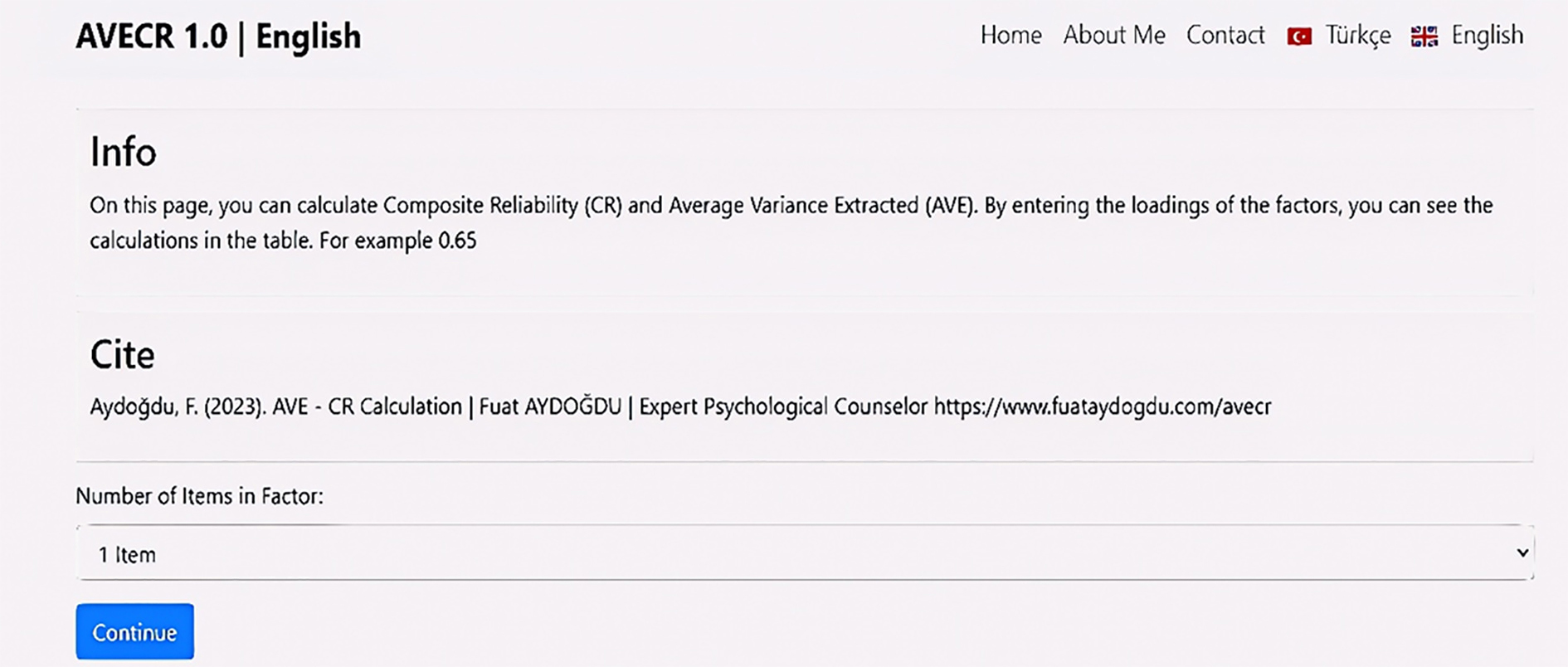
Figure 1. This figure shows an online calculation tools for selected psychometric indices (AVECR 1.0) https://fuataydogdu.com/avecr/index2.php
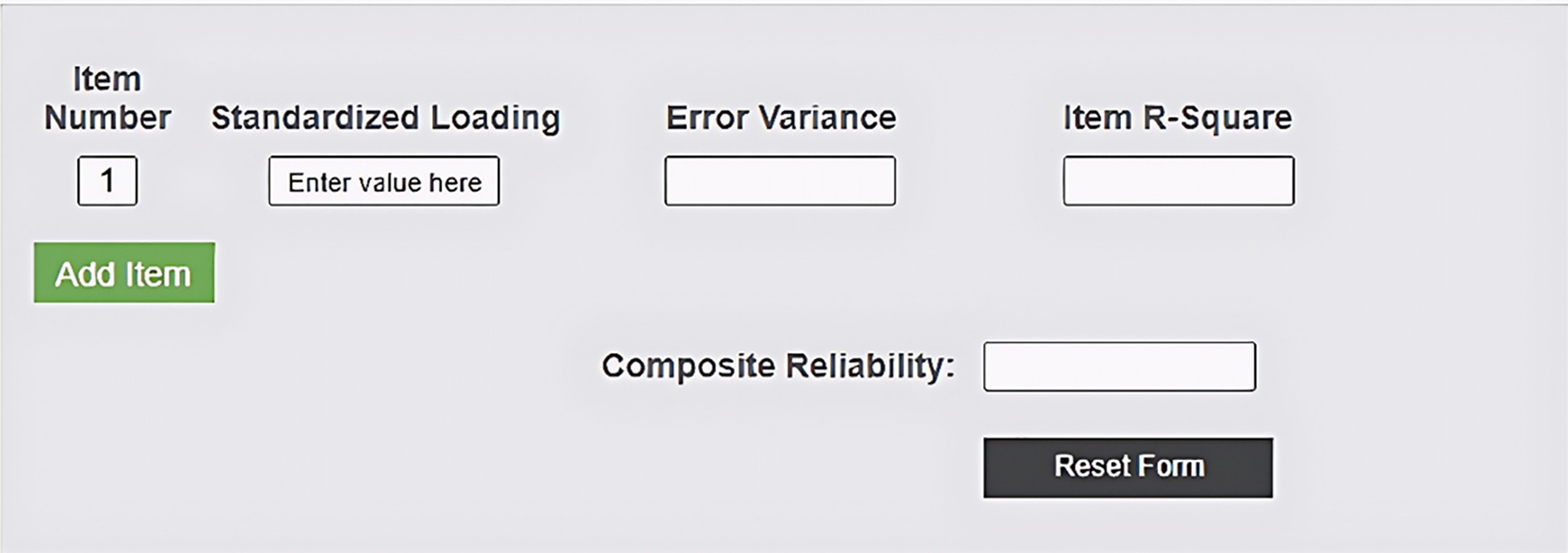
Figure 2. This figure shows an online calculation tools for selected psychometric indices (statistical mind) https://www.thestatisticalmind.com/calculators/comprel/composite_reliability.htm
The AVECR 1.0 online tool is used for structural equation modeling (SEM) and psychometric analyses. Researchers can calculate convergent validity and CR by entering factor loadings. Users first specify the number of items per construct and input the corresponding factor loadings; the tool then automatically displays AVE and CR values. AVE values above 0.50 and CR above 0.70 indicate favorable convergent validity and CR (figure 1).
The Statistical Mind provides a set of web-based statistical tools, including a CR calculator, which plays an important role in measuring the convergence and divergence of variables. These tools allow researchers to quickly calculate indices such as Cronbach’s alpha and composite validity without complex software (figure 2).
Practical and Implementation Challenges of Convergent and Divergent Validity and Composite Reliability Indices
The assessment of convergent validity, divergent validity, and CR indices in psychometric research is critical, yet it presents several practical challenges.
Convergent validity, which evaluates the extent to which multiple indicators of the same construct correlate, relies heavily on accurate calculation of metrics such as the AVE. Miscalculations or misinterpretations of AVE values can lead to erroneous conclusions regarding construct validity. Divergent validity, which ensures distinct constructs are indeed different, often depends on comparisons between AVE and maximum shared variance (MSV) or average shared variance (ASV). Improper application of these criteria or incomplete reporting can obscure true discriminant validity.
CR, which estimates the internal consistency of latent constructs using factor loadings from confirmatory factor analysis (CFA), is often misinterpreted or conflated with Cronbach’s Alpha. While both CR and Cronbach’s Alpha are internal consistency measures, they are distinct. Cronbach’s Alpha assumes tau-equivalence (equal item loadings), whereas CR allows for varying item contributions. Thus, CR generally provides a more accurate reliability estimate, particularly in the context of structural equation modeling. These indices are best viewed as complementary, with CR offering a more nuanced assessment when the assumption of equal item contributions is not met.
Additional challenges include insufficient sample sizes that undermine statistical power, missing data, and computational complexity, which may deter researchers without advanced statistical training. The lack of standardized guidelines and accessible computational tools further exacerbates these difficulties. Therefore, clear methodological guidance and user-friendly tools are essential for the valid and reliable application of these indices in psychometric evaluations.
In conclusion, understanding convergent validity, divergent validity, and CR is essential for ensuring the accuracy and reliability of measurement scales in psychological and related research. These concepts not only serve as the foundation for evaluating the psychometric properties of instruments but also play a critical role in enhancing the overall quality of research findings. When researchers grasp these principles, they are better equipped to select or develop measurement tools that genuinely reflect their intended constructs.
By utilizing appropriate formulas and online calculation tools, researchers can confidently assess the validity and reliability of their measures. This process involves not only applying statistical methods but also interpreting results within the research context. For instance, strong convergent validity may support using a new scale alongside established measures, while strong divergent validity can help clarify the uniqueness of the measured construct.
Furthermore, assessing CR ensures that the scales are not only valid but also consistent across different populations and settings. This consistency is crucial for drawing informed conclusions and making recommendations based on the research outcomes.
Authors’ Contribution
Both authors contributed in study concept, data gathering, and drafting. All authors have read and approved the final manuscript and agree to be accountable for all aspects of the work in ensuring that questions related to the accuracy or integrity of any part of the work are appropriately investigated and resolved.
Declaration of AI
We use ChatGPT to parapharise and improve English.
Conflict of Interest
None declared.
References
- Watson D, O’Hara MW, Chmielewski M, McDade-Montez EA, Koffel E, Naragon K, et al. Further validation of the IDAS: evidence of convergent, discriminant, criterion, and incremental validity. Psychol Assess. 2008; 20:248-59. DOI | PubMed
- Ledger S, Bin YS, Nour M, Cistulli P, Bauman A, Allman-Farinelli M, et al. Internal consistency and convergent and divergent validity of the Liverpool jetlag questionnaire. Chronobiol Int. 2020; 37:218-26. DOI | PubMed
- Ronkko M, Cho E. An updated guideline for assessing discriminant validity. Organizational research methods. 2022; 25:6-14. DOI
- Colwell SR. The composite reliability calculator User’s guide. Technical Report. 2016.
- Bardak F, Mamatoğlu N. Çalışanlar İçin İçsel Motivasyon Ölçeği: Geçerlilik ve Güvenirlik Çalışması. Humanistic Perspective. 2023; 5:1072-97. DOI


