
What’s Known
Spontaneous intracranial hypotension (SIH) is an underdiagnosed cause of neurological symptoms and is often linked to cerebrospinal fluid leaks. Postpartum SIH is poorly characterized, and its symptoms overlap with other peripartum conditions, making diagnosis challenging.
What’s New
This study identified SIH as a relatively common cause of postpartum central nervous system (CNS) symptoms, found in 16.4% of patients. Specific magnetic resonance imaging (MRI) findings—particularly pachymeningeal enhancement, dural distension, pituitary enlargement, and brain sagging—showed significant diagnostic value in cases where clinical features were nonspecific.
Introduction
Spontaneous intracranial hypotension (SIH) is an underdiagnosed neurologic condition most commonly caused by spontaneous spinal cerebrospinal fluid (CSF) leaks, which may occur in the absence of trauma or iatrogenic intervention. 1 , 2 SIH could present with a wide range of non-specific neurological symptoms, most prominently orthostatic headache, as well as visual disturbances, nausea, vomiting, neck stiffness, auditory changes, cognitive dysfunction, and even seizures. 1 , 3 , 4 Although orthostatic headache has played a central role in the diagnosis of SIH, current criteria include: 1) CSF opening pressure <60 mm H2O or 2) radiologic features compatible with a CSF leak. 3 Recent studies have broadened the understanding of CSF leak mechanisms beyond dural tears to include spinal meningeal diverticula, CSF-venous fistulas, and dural ectasia. 5 The clinical relevance of these entities has grown with improvements in imaging and classification systems. Brain magnetic resonance imaging (MRI), particularly with gadolinium contrast, plays a pivotal role in the initial evaluation of suspected SIH. 1 Hallmark imaging findings include diffuse pachymeningeal enhancement, venous sinus engorgement, sagging of the brain, pituitary hyperemia, and effacement of CSF cisterns. 1 , 6
Pregnancy and the postpartum period introduce unique physiological dynamics that may both obscure and potentiate the clinical manifestations of SIH. 4 , 7 - 9 Increased intra-abdominal pressure during gestation may temporarily redistribute CSF volume cephalad, attenuating symptoms. However, after delivery, the abrupt shift in pressure dynamics—combined with hormonal and vascular changes—may unmask or exacerbate underlying CSF leaks, leading to the reappearance of neurological symptoms. 4 Valsalva maneuvers during labor and spinal or epidural anesthesia have also been proposed as possible contributors to dural compromise, although spontaneous cases occur in their absence. 7 , 10 , 11 These factors complicate the diagnostic landscape in peripartum patients, where symptoms of SIH can overlap with conditions such as eclampsia, posterior reversible encephalopathy syndrome (PRES), and post-dural puncture headache. 12
Despite increasing recognition of SIH in general neurology, its epidemiology, clinical presentation, and imaging characteristics remain poorly studied in obstetric populations, with only a few case series and scattered reports addressing this unique population. 7 , 9 , 13 As a result, this study aimed to determine the diagnostic value of both clinical features and radiological assessments in identifying SIH among postpartum patients presenting with central nervous system (CNS) symptoms.
Materials and Methods
This retrospective observational study was conducted at Qaem Hospital, a tertiary referral center affiliated with Mashhad University of Medical Sciences, Mashhad, Iran. The study included postpartum patients presenting with CNS manifestations who underwent brain MRI evaluation between March 2010 and March 2023. Ethical approval was obtained from the institutional review board of Mashhad University of Medical Sciences (code: IR.MUMS.IRH.REC.1403.114). Informed consent was waived due to the retrospective nature of the study, and all data were anonymized to ensure patient confidentiality. The study adhered to the tenets of the Declaration of Helsinki.
Study Population
The inclusion criteria comprised postpartum women with neurological complaints, such as headache, seizure, or altered mental status, who underwent brain MRI within 6 weeks postpartum. Patients were excluded if they had a traumatic delivery, previously diagnosed CNS disorders (e.g., multiple sclerosis, epilepsy), or incomplete clinical or imaging records.
Demographic and clinical data—including age, comorbidities (e.g., hypertension, diabetes mellitus), seizure history, history of pre-eclampsia, mode of delivery, and anesthesia type—were extracted from electronic medical records. Neurological signs and symptoms were systematically recorded, including orthostatic headache, blurred vision, diplopia, seizure, psychotic symptoms, and loss of consciousness.
Radiological Assessment
MRI scans were performed using a 1.5-Tesla Magnetom Avanto system (Siemens Healthineers, Erlangen, Germany). This short-bore, superconducting scanner has a 60 cm bore diameter and a maximum gradient strength of 45 mT/m. All brain MRI scans were performed using standard imaging protocols, including contrast-enhanced T1-weighted sequences.
To minimize interpretation bias, all images were anonymized before evaluation. A research coordinator, not involved in image interpretation, removed patient identifiers, clinical summaries, and diagnostic impressions from the imaging files. Each case was assigned a random numerical code. The MRI datasets were then independently reviewed by a board-certified neuroradiologist with more than 10 years of experience in neuroimaging, who was blinded to all clinical information, including patients’ symptoms, delivery type, and final diagnosis. After all imaging assessments were completed, the coded results were matched with the corresponding clinical data for statistical analysis. Diagnostic features assessed and recorded included pachymeningeal enhancement, dural venous sinus distension, brain sagging, pituitary gland enlargement, intracerebral hematoma, and pachymeningitis.
The diagnosis of SIH was made based on clinical suspicion, in conjunction with supportive MRI findings, in accordance with the International Classification of Headache Disorders, third edition (ICHD-3) criteria. 3
Statistical Analysis
All data analyses were conducted using IBM SPSS Statistics (version 26, IBM Corp., Armonk, NY, USA). Descriptive statistics were used to summarize demographic, clinical, and imaging features. Comparative analyses were performed between the SIH and non-SIH groups using either Fisher’s exact test or the Chi squared test. A P<0.05 was considered statistically significant.
Results
A total of 183 postpartum patients with CNS manifestations were included over 13 years at Qaem Hospital, Mashhad University of Medical Sciences. As summarized in table 1, MRI findings were normal in 85 (46.5%) patients. PRES was the most common abnormal diagnosis (30.1%), followed by spontaneous intracranial hypotension (SIH) in 16.4%. Less frequent findings included cerebral infarction (2.7%), cerebral venous thrombosis (1.6%), subarachnoid hemorrhage (1.1%), arachnoid cyst (0.6%), hypoxic-ischemic encephalopathy (0.6%), and intraparenchymal hemorrhage (0.6%).
| Diagnosis | Frequency n (%) (n=183) |
|---|---|
| Normal | 85 (46.5%) |
| PRES | 55 (30.1%) |
| SIH | 30 (16.4%) |
| Cerebral infarction | 5 (2.7%) |
| CVT | 3 (1.6%) |
| SAH | 2 (1.1%) |
| Arachnoid cyst | 1 (0.6%) |
| HIE | 1 (0.6%) |
| IPH | 1 (0.6%) |
| MRI: Magnetic resonance imaging; CNS: Central nervous system; PRES: Posterior reversible encephalopathy syndrome; SIH: Spontaneous intracranial hypotension; CVT: Cerebral venous thrombosis; SAH: Subarachnoid hemorrhage; HIE: Hypoxic-ischemic encephalopathy; IPH: Intraparenchymal hemorrhage | |
Of the 183 postpartum patients with CNS manifestations, 30 were diagnosed with SIH based on MRI evaluation, compared with 153 non-SIH cases. As shown in table 2, there were no significant differences between the groups in terms of hypertension (P=0.31), diabetes mellitus (P=0.73), seizure history (P=0.26), or pre-eclampsia (P>0.99). Gynecologic factors such as cesarean delivery (66.7% vs. 67.3%, P=0.94) and spinal anesthesia (30.0% vs. 28.8%, P=0.89) were also comparable between groups.
| Event | SIH (n=30) | Non-SIH (n=153) | P value |
|---|---|---|---|
| HTN | 1 (3.3%) | 16 (10.5%) | 0.31 |
| DM | 3 (10.0%) | 13 (8.5%) | 0.73 |
| History of seizure | 2 (6.7%) | 25 (16.3%) | 0.26 |
| History of pre-eclampsia | 7 (23.3%) | 37 (24.2%) | >0.99 |
| Cesarean delivery | 20 (66.7%) | 103 (67.3%) | 0.94 |
| Spinal anesthesia | 9 (30%) | 44 (28.8%) | 0.89 |
| SIH: Spontaneous intracranial hypotension; HTN: Hypertension; DM: Diabetes mellitus; Comparisons were carried out using either Fisher’s exact test or Chi square test. P<0.05 was considered statistically significant. | |||
Clinical symptoms are presented in table 3. Orthostatic headache was the most frequently reported symptom among SIH patients (63.3%), followed by seizure (43.3%), blurred vision (16.7%), and diplopia (13.3%). However, none of the evaluated symptoms showed statistically significant differences between the SIH and non-SIH groups, including loss of consciousness (P=0.50), nausea and vomiting (P=0.60), paresis (P>0.99), aphasia (P>0.99), and psychotic symptoms (P>0.99).
| Sign/Symptom | SIH (n=30) | Non-SIH (n=153) | P value |
|---|---|---|---|
| Current seizure | 13 (43.3%) | 83 (54.2%) | 0.32 |
| LOC | 4 (13.3%) | 14 (9.2%) | 0.50 |
| Blurred vision | 5 (16.7%) | 23 (15.0%) | 0.79 |
| Diplopia | 4 (13.3%) | 11 (7.2%) | 0.28 |
| Orthostatic headache | 19 (63.3%) | 73 (47.7%) | 0.16 |
| Nausea and vomiting | 0 (0.0%) | 7 (4.6%) | 0.60 |
| Paresis | 1 (3.3%) | 6 (3.9%) | >0.99 |
| Aphasia | 0 (0.0%) | 2 (1.3%) | >0.99 |
| Psychotic symptoms | 0 (0.0%) | 4 (2.6%) | >0.99 |
| SIH: Spontaneous intracranial hypotension; LOS: Loss of consciousness; Comparisons were carried out using either Fisher’s exact test or Chi square test. P<0.05 was considered statistically significant. | |||
Table 4 outlines MRI features associated with SIH. Pachymeningeal enhancement was significantly more common in the SIH group (56.7% vs. 4.6%, P<0.001), followed by dural venous sinus distension (16.7% vs. 0.0%, P<0.001), pituitary gland enlargement (13.3% vs. 2.0%, P=0.01), and brain sagging (10.0% vs. 0.0%, P<0.01). Although intracerebral hematoma and pachymeningitis were observed only in the SIH group, the difference was not statistically significant (P=0.16 for both). Characteristic examples of these brain MRI findings are shown in figure 1.
| MRI Finding | SIH (n=30) | Non-SIH (n=153) | P value |
|---|---|---|---|
| Sagging | 3 (10.0%) | 0 (0.0%) | 0.004* |
| Pituitary gland enlargement | 4 (13.3%) | 3 (2.0%) | 0.01* |
| Intracerebral hematoma | 1 (3.3%) | 0 (0.0%) | 0.16 |
| Pachymeningitis1 (3.3%) | 0 (0.0%) | 0.16 | |
| Dural distension | 5 (16.7%) | 0 (0.0%) | <0.001* |
| Meningeal enhancement | 17 (56.7%) | 7 (4.6%) | <0.001* |
| MRI: Magnetic resonance imaging; SIH: Spontaneous intracranial hypotension; Comparisons were carried out using either Fisher’s exact test or Chi square test. *P<0.05 was considered statistically significant | |||
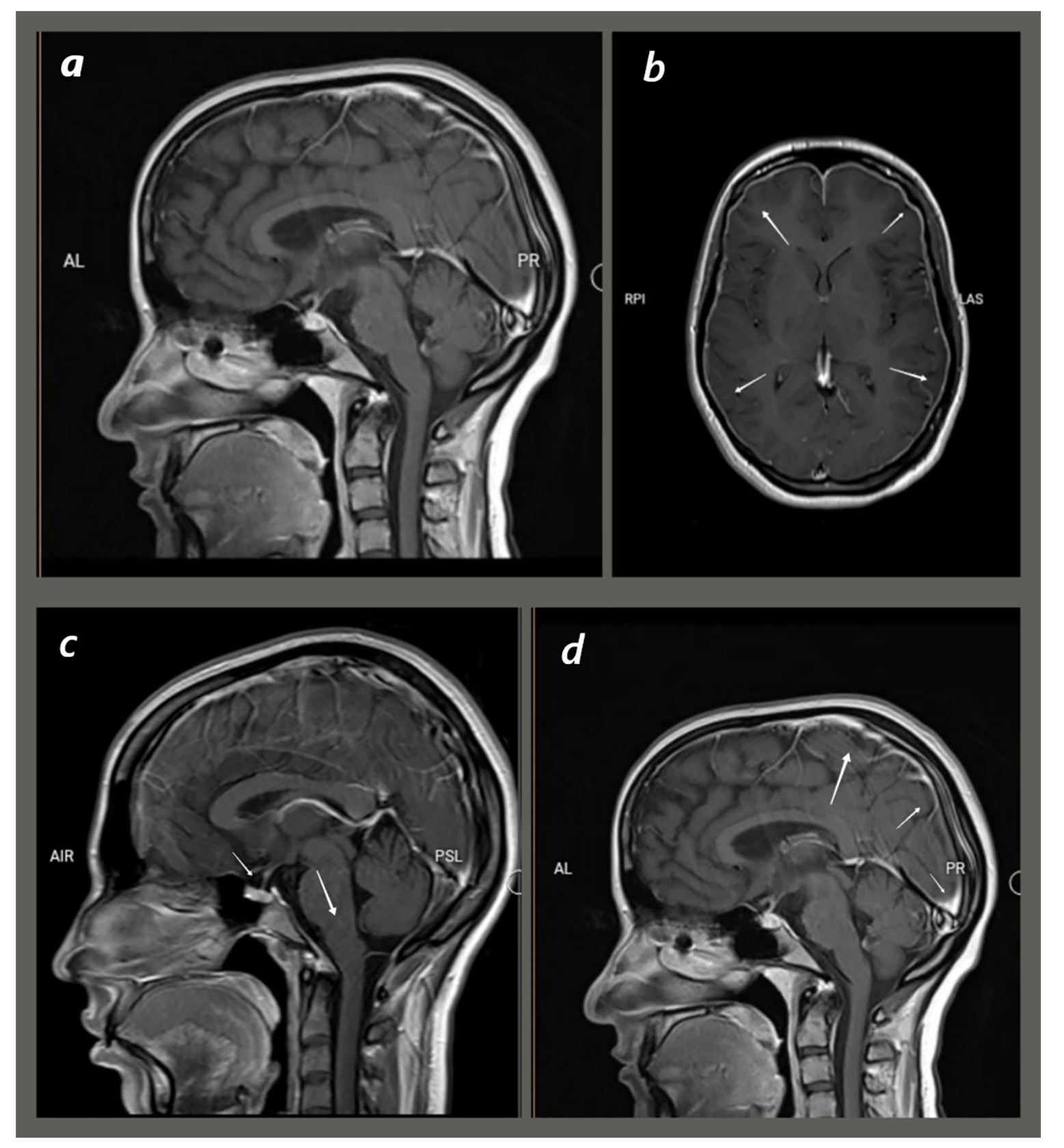
Figure 1. This figure illustrates the post-contrast brain MRI findings in postpartum patients with spontaneous intracranial hypotension. (a) Sagittal T1-weighted image shows diffuse enlargement and homogeneous enhancement of the pituitary gland. (b) Axial T1-weighted post-contrast image demonstrates linear dural enhancement along the falx and tentorium (arrows), consistent with pachymeningeal enhancement. (c) The shorter (upper) arrow points to the midbrain-pons junction, demonstrating downward displacement (brain sagging) of the midbrain. The longer (lower) arrow points to the ventral surface of the pons, illustrating pontine flattening with effacement of the prepontine cistern (cerebellar tonsillar herniation is absent). (d) Sagittal post-contrast T1-weighted image shows venous engorgement of the dural venous sinuses (arrows).
Discussion
In this retrospective review of postpartum patients presenting with CNS manifestations, SIH emerged as the third most common diagnosis after normal findings and PRES. SIH was diagnosed in approximately 16% of patients, underscoring its notable prevalence in the postpartum population with neurological presentations.
Although some clinical manifestations were prevalent among SIH patients, they lacked specificity. Orthostatic headache, nausea, and diplopia were reported with similar frequency across both SIH and non-SIH patients. 14 This observation was consistent with previous research indicating that while orthostatic headache was present in almost all SIH patients, other symptoms were variable and frequently misattributed to common peripartum conditions. 1 , 4 , 13 A meta-analysis by D’Antona and colleagues reported a 92% frequency of orthostatic headache, followed by nausea—the second most prevalent manifestation—which was observed in only half of the SIH cases. 1 However, Callen and colleagues demonstrated that up to 40% of SIH patients, particularly those with spinal CSF-venous fistulas, did not even exhibit classic orthostatic features or experience relief when supine, complicating diagnosis based on clinical presentations alone. 15
Our findings revealed that contrast-enhanced brain MRI significantly improved diagnostic confidence. Typical MRI findings, including pachymeningeal enhancement, brain sagging, pituitary gland enlargement, and dural venous engorgement, were significantly more common among SIH patients. These results were in agreement with those of Dobrocky and colleagues, who proposed a predictive MRI scoring system based on these imaging features to assess the likelihood of a CSF leak. Six Brain MRI features were used to develop this model, with three being labeled as major (pachymeningeal enhancement, venous sinus engorgement, and suprasellar cistern effacement≤4.0 mm) and three as minor (subdural fluid accumulation, prepontine cistern effacement ≤5.0 mm, and mamillopontine distance ≤6.5 mm). 16 Similarly, Li and colleagues reported diffuse pachymeningeal enhancement in over 95% of SIH cases, along with less frequent findings of brain sagging and venous engorgement. 17
Moreover, D’Antona’s meta-analysis of over 144 papers revealed that brain MRI demonstrated the highest diagnostic sensitivity, with diffuse pachymeningeal enhancement identified in 73% of SIH cases. 1 .Similarly, Balkan and colleagues described how SIH might mimic aseptic meningitis, including overlapping CSF findings and fever, and showed that diffuse pachymeningeal enhancement on MRI was instrumental in achieving diagnostic clarity. 18 For patients in whom lumbar puncture is non-diagnostic, as up to one-third of SIH cases might present with normal opening pressures, neuroimaging plays the central role. 1 , 4 , 14 In pregnant individuals, where gadolinium contrast is contraindicated, fat-suppressed T2-weighted spinal MRI remains the preferred alternative for CSF leak detection. 4
PRES was the most frequent abnormal diagnosis in our study, and an overlap with SIH was observed in some cases. Chondrogiorgi and colleagues and Zhai and Guo previously described postpartum cases in which intracranial hypotension preceded or contributed to the development of PRES. Sympathetic overactivation due to low CSF pressure has been postulated as a mechanism leading to cerebral vasospasm and resultant vasogenic edema. 7 , 19
Although treatment outcomes were not assessed in our study, the literature indicated favorable response rates to conservative management. Li and colleagues reported symptom resolution in the majority of cases without the need for invasive procedures. 17 When necessary, an epidural blood patch (EBP) is the most widely used intervention. 1 Rohatgi and colleagues reported a 64% success rate for first-attempt non-targeted EBP in peripartum patients. However, pinpointing the leak source can be challenging in this population due to concerns over radiation exposure from CT or digital subtraction myelography. 4 , 9
An additional consideration is the potential thrombotic risk posed by prolonged immobilization in postpartum patients, a population already in a hypercoagulable state. Therefore, bed rest should be cautiously limited to 7-10 days to mitigate this risk. 4 , 20
The role of physical strain, including Valsalva maneuvers, during labor and the postpartum period, is another clinically relevant issue. Although previous case reports suggested that activities such as sneezing or intercourse may precipitate SIH in predisposed individuals, 7 , 10 , 11 Ferrante and colleagues reported no recurrence of SIH in women undergoing spontaneous vaginal delivery despite the Valsalva efforts required. 20 Thus, while mechanical strain may theoretically contribute to leak formation, available evidence does not support avoiding vaginal delivery solely for this reason. 20 , 21
This study had several limitations. First, its retrospective design inherently limited causal inference and was subject to potential information bias due to incomplete or inconsistent clinical documentation. Second, reliance on MRI findings alone might have led to under- or overdiagnosis of SIH. Third, the absence of follow-up data precluded assessment of clinical outcomes or therapeutic response, which could have provided insight into prognostic implications. Additionally, the study was conducted at a single tertiary referral center, potentially introducing referral bias and limiting generalizability to broader populations—especially those managed in community settings or with less access to advanced neuroimaging. Future research should aim to validate these findings in prospective, multicenter studies with standardized diagnostic pathways. Longitudinal studies capturing treatment outcomes, particularly comparing conservative versus interventional approaches in postpartum SIH, are also warranted.
Conclusion
In summary, SIH is a frequently overlooked yet clinically significant cause of postpartum CNS symptoms. Given that classic symptoms such as orthostatic headache are not universally present and lumbar puncture may yield normal opening pressures, clinicians should maintain a high index of suspicion for SIH in postpartum patients presenting with unexplained CNS manifestations. Our findings emphasized the pivotal diagnostic role of contrast-enhanced brain MRI, particularly when clinical features are nonspecific or overlap with other peripartum conditions.
Acknowledgment
This manuscript was extracted from a student’s thesis, Nafiseh Akbari (grant number: 4030627).
Authors’ Contribution
F.S.T contributed to the conceptualization, methodology, project administration, supervision, validation, and drafting of the original manuscript. A.D contributed to conceptualization, methodology, formal analysis, interpretation of findings, writing the original draft, as well as reviewing and editing the final manuscript. M.E contributed to conceptualization, methodology, and formal analysis. N.A handled project administration, methodology, supervision, data curation, and manuscript writing and review. All authors reviewed the manuscript and have read and approved the final manuscript and agree to be accountable for all aspects of the work in ensuring that questions related to the accuracy or integrity of any part of the work are appropriately investigated and resolved.
Declaration of AI
The authors also acknowledge the use of a large language model (ChatGPT, OpenAI, San Francisco, CA) for language editing and style improvements in the manuscript draft. The authors accept full responsibility for the final content and all editorial decisions.
Conflict of Interest
None declared.
References
- D’Antona L, Jaime Merchan MA, Vassiliou A, Watkins LD, Davagnanam I, Toma AK, et al. Clinical Presentation, Investigation Findings, and Treatment Outcomes of Spontaneous Intracranial Hypotension Syndrome: A Systematic Review and Meta-analysis. JAMA Neurol. 2021; 78:329-37. Publisher Full Text | DOI | PubMed [ PMC Free Article ]
- McRae-Posani B, Kim A, Edasery D, Strauss S, Roytman M, Park JK, et al. Spinal CSF leaks in spontaneous intracranial hypotension: A single-institution analysis of incidence, typology and treatment outcomes. Clin Neurol Neurosurg. 2025; 255:108978. DOI | PubMed
- Headache Classification Committee of the International Headache Society (IHS) The International Classification of Headache Disorders, 3rd edition. Cephalalgia. 2018; 38:1-211. DOI | PubMed
- Rohatgi VK, Robbins MS, Roytman M, Chazen JL. Spontaneous Intracranial Hypotension in Pregnancy. Curr Pain Headache Rep. 2023; 27:685-93. DOI | PubMed
- Schievink WI. Spontaneous Intracranial Hypotension. N Engl J Med. 2021; 385:2173-8. DOI | PubMed
- Ferrante E, Trimboli M, Petrecca G, Allegrini F, Ferrante MM, Rubino F. Management of Spontaneous Intracranial Hypotension During Pregnancy: A Case Series. Headache. 2020; 60:1777-87. DOI | PubMed
- Chondrogiorgi M, Zikou AK, Konitsiotis S, Markoula S. Postpartum intracranial hypotension complicated by posterior reversible encephalopathy syndrome: a case report. Int J Neurosci. 2020; 130:1174-7. DOI | PubMed
- McGrath E, Monaghan TS, Alexander M, Hennessy MJ. Recurrent spontaneous intracranial hypotension in early pregnancy. BMJ Case Rep. 2010; 2010Publisher Full Text | DOI | PubMed [ PMC Free Article ]
- Reihani H, Zarei F, Soltani A, Saeedi-Moghadam M. A notable improvement in spontaneous intracranial hypotension (SIH) after delivery in a pregnant woman: A case report. Radiol Case Rep. 2022; 17:3763-6. Publisher Full Text | DOI | PubMed [ PMC Free Article ]
- Pereira AI, Fernandes DL, Amorim A, Nunes S. Cerebrospinal fluid fistula after combined spinal-epidural block. BMJ Case Rep. 2022; 15Publisher Full Text | DOI | PubMed [ PMC Free Article ]
- Bos EM, van der Lee K, Haumann J, de Quelerij M, Vandertop WP, Kalkman CJ, et al. Intracranial hematoma and abscess after neuraxial analgesia and anesthesia: a review of the literature describing 297 cases. Reg Anesth Pain Med. 2021; 46:337-43. Publisher Full Text | DOI | PubMed [ PMC Free Article ]
- Orehek EK, Burns JD, Koyfman F, Azocar RJ, Holsapple JW, Green DM. Postpartum trifecta: simultaneous eclamptic intracerebral hemorrhage, PRES, and herniation due to intracranial hypotension. Neurocrit Care. 2012; 17:434-8. DOI | PubMed
- van Sonderen A, Koppen H. Postpartum spontaneous intracranial hypotension. Am J Emerg Med. 2013; 31:461. DOI | PubMed
- Dobrocky T, Nicholson P, Häni L, Mordasini P, Krings T, Brinjikji W, et al. Spontaneous intracranial hypotension: searching for the CSF leak. Lancet Neurol. 2022; 21:369-80. DOI | PubMed
- Callen AL, Han L, Pisani Petrucci SL, Andonov N, Lennarson P, Birlea M, et al. Patterns of clinical and imaging presentations in patients with spontaneous intracranial hypotension due to spinal cerebrospinal fluid venous fistula: A single-center retrospective cross-sectional study. Headache. 2024; 64:939-49. DOI | PubMed
- Dobrocky T, Grunder L, Breiding PS, Branca M, Limacher A, Mosimann PJ, et al. Assessing Spinal Cerebrospinal Fluid Leaks in Spontaneous Intracranial Hypotension With a Scoring System Based on Brain Magnetic Resonance Imaging Findings. JAMA Neurol. 2019; 76:580-7. Publisher Full Text | DOI | PubMed [ PMC Free Article ]
- Li C, Raza HK, Chansysouphanthong T, Zu J, Cui G. A clinical analysis on 40 cases of spontaneous intracranial hypotension syndrome. Somatosens Mot Res. 2019; 36:24-30. DOI | PubMed
- Balkan, II, Albayram S, Ozaras R, Yilmaz MH, Ozbayrak M, Mete B, et al. Spontaneous intracranial hypotension syndrome may mimic aseptic meningitis. Scand J Infect Dis. 2012; 44:481-8. DOI | PubMed
- Zhai Z, Guo Y. Posterior reversible encephalopathy syndrome induced by intracranial hypotension in a postpartum patient. Int J Neurosci. 2021; 131:65-9. DOI | PubMed
- Ferrante E, Rubino GF, Ferrante MM. Can the Valsalva maneuver during delivery effort cause a recurrence of spontaneous intracranial hypotension? Eur J Obstet Gynecol Reprod Biol. 2015; 189:113-4. DOI | PubMed
- D’Amico D, Usai S, Chiapparini L, Erbetta A, Gioppo A, Messina G, et al. Headache in spontaneous intracranial hypotension: an overview with indications for differential diagnosis in the clinical practice. Neurol Sci. 2020; 41:423-7. DOI | PubMed

