
What’s Known
L-menthol had antinociceptive effects in acute and chronic pain in animal models. Numerous studies show that there are male and female differences in the response to the antinociceptive effects of analgesic drugs.
What’s New
L-menthol showed higher antinociceptive effects in both the hot plate and acetic acid tests in male mice than in female mice. L-menthol showed no significant side effects, including changes in behavior or motor coordination.
Introduction
L-menthol is an alcoholic monoterpene, a main component of the mint species, whose therapeutic effects date back to 1708, to Hippocrates. 1 Menthol has four optical isomers, of which L-menthol has been reported to have analgesic, antibacterial, antifungal effects, anesthetic properties, improving flatulent dyspepsia and nausea. 1 , 2 Etemad and others showed that the combination of phenol 1% and menthol 1% was more effective than placebo in reducing the skin pruritus of delayed cutaneous complications of veterans. 3 Other studies have investigated the antinociceptive effect of L-menthol in animal models. Rocha and others showed that L-menthol (2, 5, and 10 mg/L for one hour) reduced nociception in zebrafish (Danio rerio) larvae, using 0.05% acetic acid test for one min in 24-well plates, as an acute pain model, by analysing the activity of acetylcholinesterase. 4 Moreover, Silveira and others reported that L-menthol had analgesic effects on the acid-induced writhing, hot plate, tail flick, complete Freunds adjuant (CFA), and capsaicin tests in C57BL/6J mice. 5 Additionally, Bagdas and others reported a significant sex difference in the effect of L-menthol (30-210 µg/mL, oral, in drinking water) on nicotine intake in mice. 6 Today, treatment strategy is moving from prescribing for the public to individualized therapy, and consideration of many patient characteristics, such as genetic, gender, and disease. If gender differences in the analgesic effect of L-menthol are identified, it will provide better pain management. Although it has previously been demonstrated that there are male-female differences in the analgesic effects of the analgesic drug classes, 7 - 11 research on sex differences in the L-menthol antinociceptive effect remains limited. The goal of the present study was to investigate sex differences in the antinociceptive effects of L-menthol in mice.
Materials and Methods
Experimental Procedures
Chemicals: L-menthol (Sigma, Germany) was prepared by initially dissolving it in a drop of 50% dimethyl sulfoxide (Merck, Germany), followed by dilution in physiological saline 0.9% to achieve the desired concentration for administration. All compounds were administered via intraperitoneal injection at a volume of 2 mL/Kg of mouse body weight. Control animals received vehicle at a volume of 2 mL/Kg.
Animals and Experimental Design
Male (n=21) and female (n=21) BALB/c mice (8 weeks old; 23–30 g) obtained from the Animal Breeding Center, Shiraz University of Medical Sciences, Shiraz, Iran. The mice were transferred to our animal lab three days before the start of the experiment. Mice were placed in standard cages, seven in each, under standard conditions (12 h light/dark cycle at 7:00 AM/7:00 PM, 25±1 °C, and 20-30% humidity) with standard mice chow and tap drinking water ad libitum. 12 All procedures were carried out in accordance with the local regulations of the Animal Use and Care Committee and were approved by Shiraz University of Medical Science Ethics Committee (ethical code: IR.SUMS.AEC.1404.073). Twenty-one female mice were marked and then, using a randomizer software, each mouse was randomly assigned to one of three groups (control, L-menthol 2.5 mg/Kg, and L-menthol 5 mg/Kg). Male mice were grouped the same way. On the test day, mice were transferred to our laboratory one hour before testing. Behavioral tests were performed between 8:00 AM and 5:00 PM, and the mice were checked daily for general health, if there was a skin or tail lesion, excluded from the study. Each mouse was used once. Experiments were conducted in a blinded manner to eliminate observer bias risk. Measures to minimize suffering included acute termination on the same day at the end of tests. Experimental assays were done as follows. Two mice were used as controls daily, and an equal number of mice from each treatment group were tested to minimize the effect of differences between days. Fifteen min after injection, we did the rotarod test, then the hot plate test, and next the acetic acid test for all mice. Finally, each mouse was immediately placed in a 40×40×40 mesh cage under a camera for fifteen min to record behaviors.
The Rotarod Test Protocol
The rotarod test was conducted using a rotarod apparatus (UGO Basile, Italy). Initially, mice were trained on the rotarod at a constant speed (22 rpm) for 30 seconds for two consecutive days. During training, mice that fell from the apparatus were replaced on the spindle. After training, animals that fell before 30 seconds from the spindle were excluded from the study. On test day, 15 min after injection, immediately before the hot plate test, each mouse was placed on the spindle. The response was recorded as the ability to stand on the spindle for 30 seconds, marked as yes/no for each mouse.
The Hot Plate Test Protocol
The hot plate test was used for the thermal stimuli-induced nociception. Briefly, two days before the test day, each mouse was gently placed on a turn-off hot plate instrument (Model STUART SCIENTIFIC SH3D-England) for one-min free movement to acclimate. The next day, the hot plate temperature was set to 55 °C, and the baseline hot plate latency response time was determined for each mouse without any injection, a cut-off point of 30 seconds was used to avoid tissue injury. Baseline of the hot plate response latency time should be between 5 and 12 seconds, animals exhibiting latencies outside this range were excluded from the study. The response latency time was defined as the period from the time the animal was placed on the hot plate to the time the animal licked or lifted its hind paw or jumped. After observing the response, the mouse was taken off the hot plate immediately. On the test day, after the injection, the hot plate response latency time was determined after the rotarod test.
The Acetic Acid- Induced Writhing Test Protocol
One min after the hot plate test, abdominal writhing was induced by intraperitoneal injection of a 0.6% (v/v) solution of acetic acid (10 mL/Kg). Immediately, the mouse was placed in a transparent observation chamber, and the total number of writhes was recorded for 20 min.
The Video Behaviour Recording Protocol
After the writhing test, to assess the side effects of acute use of L-menthol, each mouse was placed in a 40×40×40 cm mesh cage. The animal behaviors were continuously recorded for 15 min using a video recorder. At the end of the experiment, the videos were observed by a researcher who was blinded to the treatment groups. The total number of each behavior, such as licking, jumping, grooming, rearing, defecation, and immobility, was recorded in a data sheet.
Statistical Analysis
We analyzed the data by SPSS statistical software version 18.0 (IBM, USA). The %MPE was calculated according to the standard formula. 13
Data are reported as mean±SEM. 2-way ANOVA was used to analyze the effect of gender, drug, and drug× gender interaction. One-way ANOVA and Tukey’s post hoc test were used for further groups comparisons. For the rotarod test, McNamer’s test was used. The nonparametric Kruskal-Wallis test was applied for the behavior tests. Statistical significance was defined at P<0.05.
Results
Sex Differences in L-menthol Antinociception in the Hot Plate Test
Female mice showed less baseline response latency time in the hot plate test, although the difference did not reach a significant level based on independent t test (P=0.055) (mean±SEM, male: 10.07±0.44 seconds, n=21; female: 7.3±0.29 seconds, n=21). 2-way ANOVA revealed significant main effects of gender (P<0.001), drug (P<0.001), and a drug×gender interaction (P=0.027). As seen in figure 1, based on one-way ANOVA analysis followed by Tukey post hoc, L-menthol (2.5 mg/Kg and 5 mg/Kg) significantly increased the mean of %MPE compared to controls in both male (P<0.001) and female (P<0.001) mice. Moreover, there was a significant sex difference in the antinociceptive effect of L-menthol 5 mg/Kg, as the %MPE was higher in males than in females (mean±SEM, male: 68.26±11.21, and female mice: 35.97±5.55; P=0.04), in another words five out of seven male mice showed the %MPE above 60, while none of the female mice showed a response above 60 at a dose of 5 mg/Kg of L-menthol.
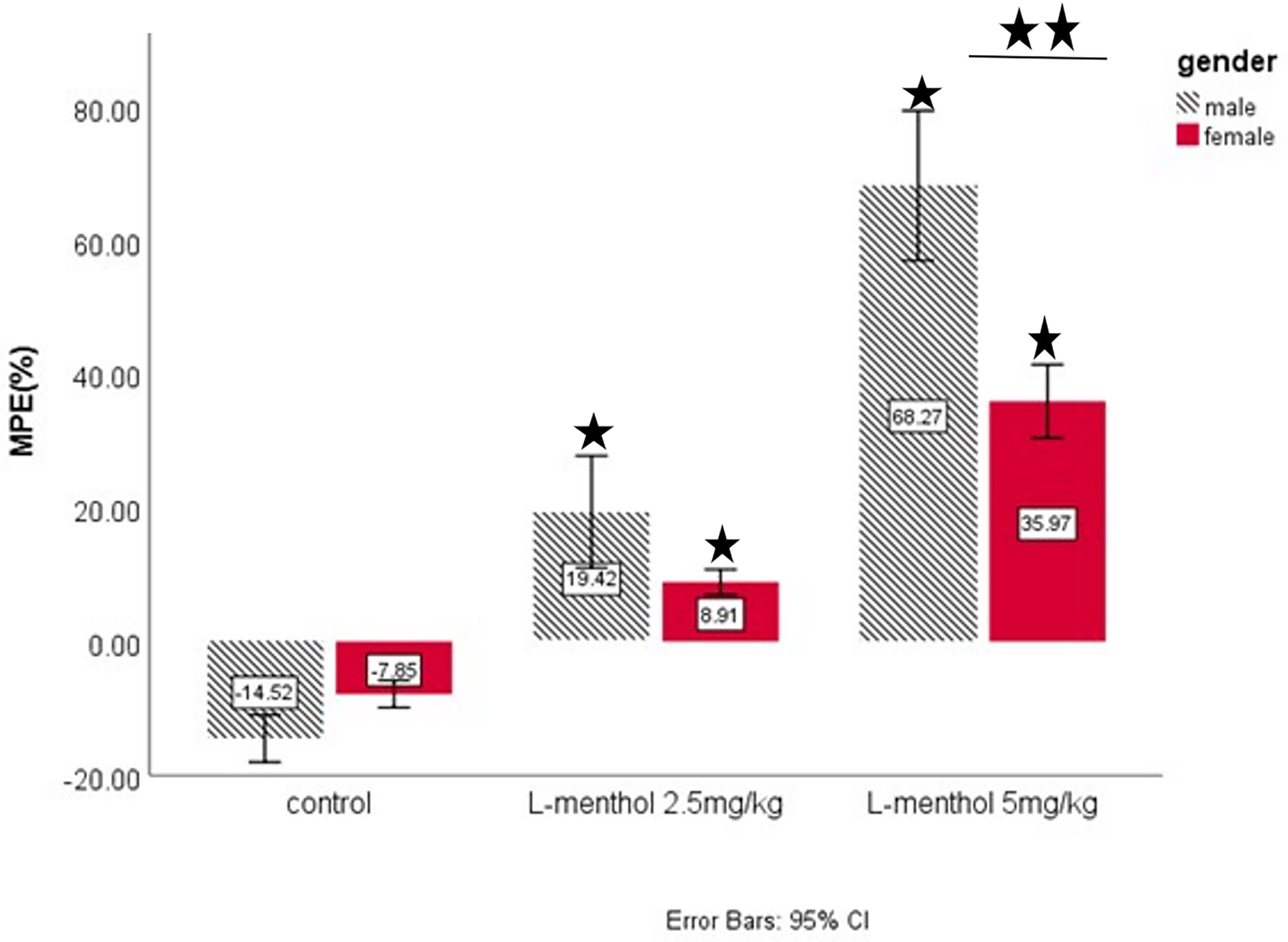
Figure 1. Sex-dependent effects of L-menthol (2.5 and 5 mg/Kg, intraperitoneal) on thermal pain evaluated as percent maximum possible effect (%MPE) in the hot plate test (55 °C) are shown. Data are presented as mean±SEM, n=7 per group. *Significant difference between L-menthol and control (P<0.001), **Significant difference between male and female (P< 0.05).The data were analyzed using the ANOVA. The Tukey test was applied for post hoc pairwise comparison when a significant result was obtained.
Sex Differences in L-menthol Antinociception in the Acetic Acid-Induced Writhing Test
2-way ANOVA showed significant main effects of gender (P<0.001), drug (P<0.001), and a drug×gender interaction (P=0.002). As shown in figure 2, based on one-way ANOVA analysis followed by Tukey post hoc test, the intraperitoneal administration of L-menthol at doses of 2.5 and 5 mg/Kg inhibited writhing response in mice significantly compared to control groups in both male (P<0.001) and female mice (P<0.001). Furthermore, a significant sex difference was observed in both the L-menthol 2.5 mg/Kg (mean±SEM, male: 20.57±2.3 and female: 35.57±3.8; P<0.001), and L-menthol 5 mg/Kg (mean±SEM, male: 10.3±1.3 and female: 23±4.5; P=0.024) groups, so that the antinociceptive effect was higher in males than in females at L-menthol 2.5 and 5 mg/Kg.
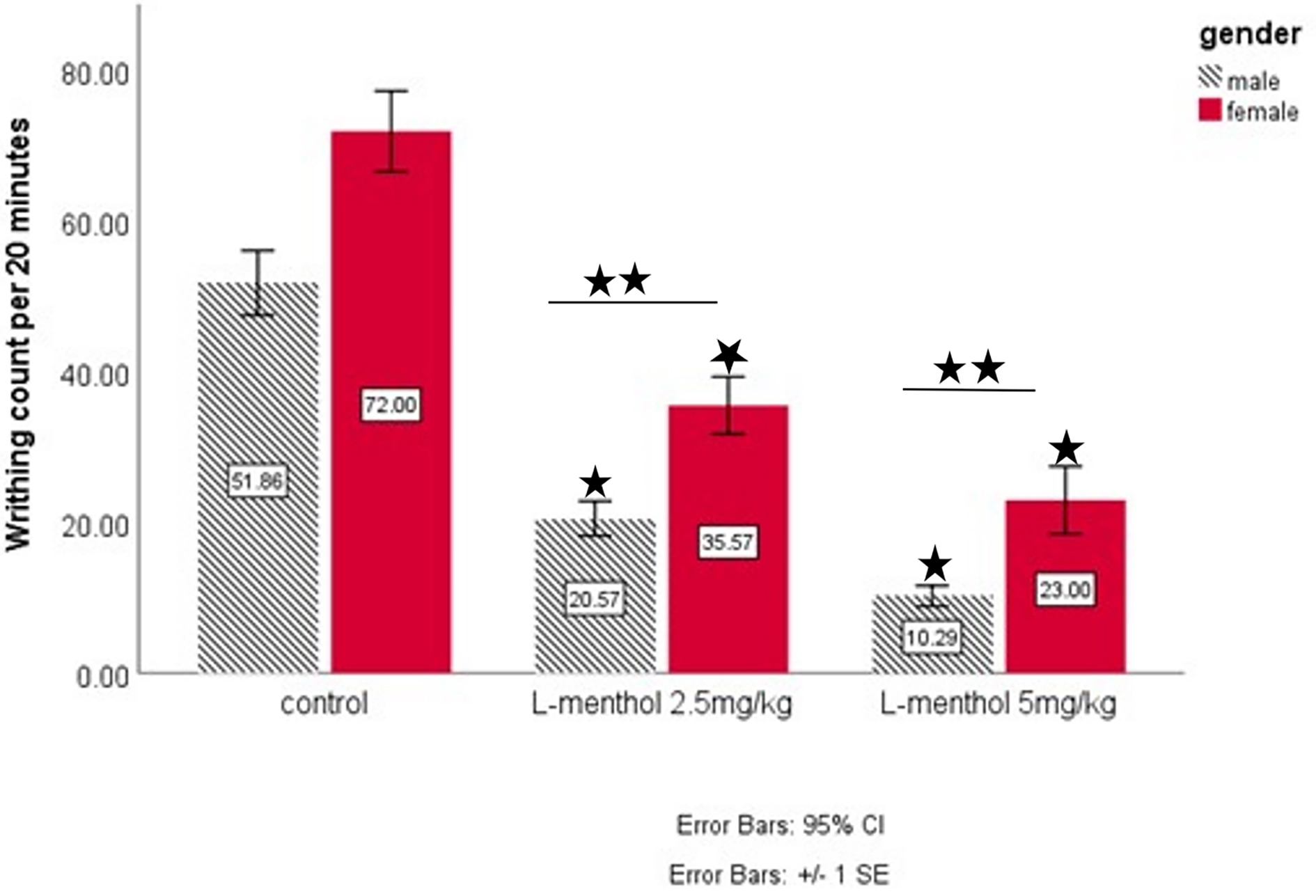
Figure 2. Sex-dependent effects of L-menthol in BALB/c mice on the writhing test are shown. Data are presented as mean±SEM, n=7 per group. *Significant difference between L-menthol and control (P<0.001). **Significant differences between male and female (P<0.05). The data were analyzed using the ANOVA. The Tukey test was applied for post hoc pairwise comparison when a significant result was obtained.
Sex Differences in L-menthol Effects in the Rotarod Test
The McNamer’s test revealed a non-significant change in falling responses before and after treatments in the rotarod test in all groups. Male mice in all groups were able to maintain their balance on the spindle for 30 seconds before and after the injections. Female mice maintained their balance on the spindle, but only one female mouse in the 5 mg/Kg L-menthol group failed to maintain its balance and fell from the spindle before 30 seconds (table 1).
| Drug | Maintained their balance on the rod | |
|---|---|---|
| Male | Female | |
| Control | 100% | 100% |
| L-menthol 2.5 mg/Kg | 100% | 100% |
| L-menthol 5 mg/Kg | 100% | 86% |
| Analyzed by the McNamer’s test; Statistically significant P<0.05. | ||
Sex Differences in L-menthol Effects in Behavioral Tests
Based on the Kruskal-Wallis test on each behavior, such as licking, rearing, and defecation, there were no significant changes in total behavior counts during 15 min, between the treatment and the control groups in both female and male mice.
Discussion
Our findings showed significant antinociceptive effects of L-menthol at 2.5 and 5 mg/Kg intraperitoneally in both male and female mice in the acetic acid test and the hot plate test, compared to control groups. These results agree with those of previous reports. 3 , 4 Li and others reviewed the analgesic effects of L-menthol 3-10 mg/Kg, oral in the hot plate and abdominal writhing tests in Swiss albino mice, which could increase pain threshold in a dose-dependent manner. 1 Additionally, L-menthol 10 mg/Kg intraperitoneal, showed to increase the response latency time in C57BL/6J mice in the hot plate and the tail flick tests. 1 In another study, Wright and others showed that L-menthol 2% and 16% topical reduced pain behavior in protoporphyrin-induced phototoxicity pain as an animal acute pain model. 14 Based on our findings, L-menthol in male mice showed higher antinociceptive effects in both the hot plate and the acetic acid tests than female mice. We could not find similar research about the sex difference in the analgesic effects of L-menthol, but Bagdas and others reported a greater effect of L-menthol on nicotine intake in male than in female mice. 6 This study also showed that female mice responded to the hot plate test more quickly than male mice, namely, females had a lower baseline latency time, but the difference was not statistically significant. However, Kest and others showed a sex difference in the baseline latency time, so that male mice exhibited significantly higher baseline tail-withdrawal latencies than their female counterparts, reflecting higher nociceptive sensitivity in female mice. 15 Moreover, Lee and others discovered that females displayed greater sensitivity than males to nociception in the context of a spinal cord injury (SCI), which they used as a neuropathic pain model, in C57BL/6J mice. 16 In contrast, Vierck and others found that in the hot plate test, male rats were more sensitive than female rats. 17
These discrepancies in the baseline response in various studies may be attributed to differences in species, strains, and animal acute pain tests employed. Additionally, motor coordination assessment using the rotarod test revealed that L-menthol had no significant effect on the muscle coordination, suggesting no motor coordination side effect and hence no bias in our nociceptive tests. Significant changes were not observed in behaviors such as licking, rearing, and defecation, comparing treatment and control groups in both male and female mice, suggesting that acute L-menthol had no side effects, at least during one hour after injection.
Hormonal cyclic changes in female mice can influence the sex differences in effects of drugs. Although, we did not identify hormonal cyclic changes, it was notable that female mice showed a lower variation (standard error of mean) than male mice in both the hot plate and chemical tests.
Therefore, we assumed that hormonal cyclic changes may not have affected our results. In this regard, Moskowitz and others found that the morphine-induced antinociceptive effect in the tail-flick test, as a model of acute thermal nociception, was not different in female mice across the ovulatory cycle. 18 Moreover, Diez and others showed that neither gonadectomy nor administration of estrogen in females or testosterone in males had detectable effects on brain opiate receptors, as measured by naloxone binding in either Sprague- Dawley rats or two different strains of C57BL/6J and Swiss albino mice. 19 A possible explanation for disparities in L-menthol-induced antinociceptive effects between the two genders might be attributed to the mechanism of action of the drug. A key mechanism through which L-menthol exerts its effects is via modulation of the transient receptor potential melastatin 8 (TRPM8) ion channels. 1 , 20 On the other hand, evidence indicates that the expression and distribution of TRPM8 ion channels differ between genders, contributing to variability in pharmacodynamic responses. 21 , 22 Consequently, recognizing gender-specific differences in TRPM8-mediated pathways could inform more personalized and effective pain management strategies. 21 Another analgesic mechanism discovered for L-menthol is kappa opioid receptor agonism. 1 , 23 Furthermore, differential distribution of kappa opioid receptors between male and female mice has been suggested, which may underlie variations in L-menthol analgesic properties. 24 - 26 Moreover, numerous studies have documented gender-related differences in the pharmacokinetics of various drug classes, including cardiovascular agents, 27 morphine, 7 , 28 ibuprofen, 29 and kappa opioid receptor agonists. 24 Azemati and others assessed pain using the objective pain scale and showed that intranasal ketamine 8 mg/Kg was effective for reducing parental separation anxiety, mask acceptance, postoperative agitation, and pain in children. 30 Sex differences in analgesic and antidepressant effects of ketamine were reviewed by Ponton and others. They reported that ketamine had a greater analgesic effect in men vs. women, which may be due to variations in cytochrome P450 (CYP) enzymes activities. The main enzymes responsible for metabolizing ketamine, CYP2B6 and CYP3A4, exhibit different activity levels, with CYP3A4 being more active in women than in men. 31 Therefore, it is speculated that particular receptors, including TRPM8 ion channels, the kappa opioid receptors, and CYP enzymes, may be involved in the differences in the L-menthol analgesic response observed between males and females in our study. Future studies should explore the mechanisms, including the use of specific antagonists and CYP enzyme activities, to determine the role of specific receptors and CYP enzymes. There are several tests, such as the tail flick, von Frey, Hargreaves, and cold plate, that reflect more types of acute pain, and can be used to further investigate sex differences. These methods could help evaluate the potential mechanisms involved in sex-based variations in the analgesic effects of L-menthol, which was a limitation in the present study.
Conclusion
The findings revealed significant sex-dependent differences in L-menthol-induced antinociceptive responses in mice, which should be considered in future clinical pain research.
Acknowledgment
The authors are grateful to Maryam Mojahed Taghi for her kind contribution to this project. This article is the first part of the PhD thesis of Maryam Ahmadnasr, and was supported by Shiraz University of Medical Science (Grant number: 31893).
Authors’ Contribution
M.A: Conceptualization and design, acquisition of data, Data analysis, and interpretation, drafting of the manuscript, editing the manuscript; BF.BBZ: Conceptualization and design, acquisition of data, data analysis, and interpretation, drafting of the manuscript, critical revision of the manuscript for scientific and factual content, methodology, reviewing and editing the manuscript; MR.P: Conceptualization and design, data interpretation, and reviewing the manuscript, A.P: Data acquisition, and drafting; Sh.B: Data acquisition, and drafting. All authors have read and approved the final manuscript and agree to be accountable for all aspects of the work in ensuring that questions related to the accuracy or integrity of any part of the work are appropriately investigated and resolved.
Declaration of AI
The authors declare that no AI tools were used in the preparation of this manuscript.
Conflict of Interest
Mohammad Reza Panjehshahin, serving as the Chairperson, played no role in the handling of this manuscript at any stage. To ensure impartiality, the Editorial Board convened a team of independent experts to review the manuscript without his involvement or awareness.
References
- Li Z, Zhang H, Wang Y, Li Y, Li Q, Zhang L. The distinctive role of menthol in pain and analgesia: Mechanisms, practices, and advances. Front Mol Neurosci. 2022; 15:1006908. Publisher Full Text | DOI | PubMed [ PMC Free Article ]
- Silva H. Current Knowledge on the Vascular Effects of Menthol. Front Physiol. 2020; 11:298. Publisher Full Text | DOI | PubMed [ PMC Free Article ]
- Etemad LPP, Moshiri MMDP, Balali-Mood MMDP. Delayed Complications and Long-Term Management of Sulfur Mustard Poisoning: A Narrative Review of Recent Advances by Iranian Researchers Part capital I, Ukrainiancapital I, Ukrainian: Clinical Management and Therapy. Iran J Med Sci. 2018; 43:235-47. Publisher Full Text | PubMed [ PMC Free Article ]
- Rocha CA, Felix LM, Monteiro SM, Venancio C. Antinociceptive Analysis of Natural Monoterpenes Eugenol, Menthol, Carvacrol and Thymol in a Zebrafish Larval Model. Pharmaceuticals (Basel). 2024; 17Publisher Full Text | DOI | PubMed [ PMC Free Article ]
- de Cassia da Silveira ESR, Lima TC, da Nobrega FR, de Brito AEM, de Sousa DP. Analgesic-Like Activity of Essential Oil Constituents: An Update. Int J Mol Sci. 2017; 18Publisher Full Text | DOI | PubMed [ PMC Free Article ]
- Bagdas D, Jackson A, Carper M, Chen RY, Akinola LS, Damaj MI. Impact of menthol on nicotine intake and preference in mice: Concentration, sex, and age differences. Neuropharmacology. 2020; 179:108274. Publisher Full Text | DOI | PubMed [ PMC Free Article ]
- Pisanu C, Franconi F, Gessa GL, Mameli S, Pisanu GM, Campesi I, et al. Sex differences in the response to opioids for pain relief: A systematic review and meta-analysis. Pharmacol Res. 2019; 148:104447. Publisher Full Text | DOI | PubMed [ PMC Free Article ]
- Packiasabapathy S, Sadhasivam S. Gender, genetics, and analgesia: understanding the differences in response to pain relief. J Pain Res. 2018; 11:2729-39. Publisher Full Text | DOI | PubMed [ PMC Free Article ]
- Fullerton EF, Doyle HH, Murphy AZ. Impact of sex on pain and opioid analgesia: a review. Curr Opin Behav Sci. 2018; 23:183-90. Publisher Full Text | DOI | PubMed [ PMC Free Article ]
- Farkouh A, Riedl T, Gottardi R, Czejka M, Kautzky-Willer A. Sex-Related Differences in Pharmacokinetics and Pharmacodynamics of Frequently Prescribed Drugs: A Review of the Literature. Adv Ther. 2020; 37:644-55. DOI | PubMed
- Smith JC. A Review of Strain and Sex Differences in Response to Pain and Analgesia in Mice. Comp Med. 2019; 69:490-500. Publisher Full Text | DOI | PubMed [ PMC Free Article ]
- Prepared by the Animal Facilities Standards Committee of the Animal Care P. Guide for Laboratory Animal Facilities and Care. ILAR J. 2021; 62:345-58. DOI | PubMed
- Dhorajiwala SS, Nerurkar RP, Singh KR. Evaluation of analgesic effects of different doses of vitamin D3 in two animal models of pain in Swiss albino mice. Indian J Pain. 2024; 38:177-83. DOI
- Wright L, Baptista-Hon D, Bull F, Dalgaty F, Gallacher M, Ibbotson SH, et al. Menthol reduces phototoxicity pain in a mouse model of photodynamic therapy. Pain. 2018; 159:284-97. DOI | PubMed
- Kest B, Wilson SG, Mogil JS. Sex differences in supraspinal morphine analgesia are dependent on genotype. J Pharmacol Exp Ther. 1999; 289:1370-5. PubMed
- Lee SE, Greenough EK, Oancea P, Scheinfeld AR, Douglas AM, Gaudet AD. Sex Differences in Pain: Spinal Cord Injury in Female and Male Mice Elicits Behaviors Related to Neuropathic Pain. J Neurotrauma. 2023; 40:833-44. DOI | PubMed
- Vierck CJ, Acosta-Rua AJ, Rossi HL, Neubert JK. Sex differences in thermal pain sensitivity and sympathetic reactivity for two strains of rat. J Pain. 2008; 9:739-49. Publisher Full Text | DOI | PubMed [ PMC Free Article ]
- Moskowitz AS, Terman GW, Carter KR, Morgan MJ, Liebeskind JC. Analgesic, locomotor and lethal effects of morphine in the mouse: strain comparisons. Brain Res. 1985; 361:46-51. DOI | PubMed
- Diez JA, Roberts DL. Evidence contradicting the notion that gonadal hormones regulate brain opiate receptors. Biochem Biophys Res Commun. 1982; 108:1313-9. DOI | PubMed
- Liu B, Fan L, Balakrishna S, Sui A, Morris JB, Jordt SE. TRPM8 is the principal mediator of menthol-induced analgesia of acute and inflammatory pain. Pain. 2013; 154:2169-77. Publisher Full Text | DOI | PubMed [ PMC Free Article ]
- Caudle RM, Caudle SL, Jenkins AC, Ahn AH, Neubert JK. Sex differences in mouse Transient Receptor Potential Cation Channel, Subfamily M, Member 8 expressing trigeminal ganglion neurons. PLoS One. 2017; 12:e0176753. Publisher Full Text | DOI | PubMed [ PMC Free Article ]
- Alarcon-Alarcon D, Cabanero D, de Andres-Lopez J, Nikolaeva-Koleva M, Giorgi S, Fernandez-Ballester G, et al. TRPM8 contributes to sex dimorphism by promoting recovery of normal sensitivity in a mouse model of chronic migraine. Nat Commun. 2022; 13:6304. Publisher Full Text | DOI | PubMed [ PMC Free Article ]
- Galeotti N, Di Cesare Mannelli L, Mazzanti G, Bartolini A, Ghelardini C. Menthol: a natural analgesic compound. Neurosci Lett. 2002; 322:145-8. DOI | PubMed
- Custodio-Patsey L, Donahue RR, Fu W, Lambert J, Smith BN, Taylor BK. Sex differences in kappa opioid receptor inhibition of latent postoperative pain sensitization in dorsal horn. Neuropharmacology. 2020; 163:107726. Publisher Full Text | DOI | PubMed [ PMC Free Article ]
- Conway SM, Puttick D, Russell S, Potter D, Roitman MF, Chartoff EH. Females are less sensitive than males to the motivational- and dopamine-suppressing effects of kappa opioid receptor activation. Neuropharmacology. 2019; 146:231-41. Publisher Full Text | DOI | PubMed [ PMC Free Article ]
- Laman-Maharg A, Williams AV, Zufelt MD, Minie VA, Ramos-Maciel S, Hao R, et al. Sex Differences in the Effects of a Kappa Opioid Receptor Antagonist in the Forced Swim Test. Front Pharmacol. 2018; 9:93. Publisher Full Text | DOI | PubMed [ PMC Free Article ]
- Tamargo J, Rosano G, Walther T, Duarte J, Niessner A, Kaski JC, et al. Gender differences in the effects of cardiovascular drugs. Eur Heart J Cardiovasc Pharmacother. 2017; 3:163-82. DOI | PubMed
- Gabel F, Hovhannisyan V, Andry V, Goumon Y. Central metabolism as a potential origin of sex differences in morphine antinociception but not induction of antinociceptive tolerance in mice. Br J Pharmacol. 2023; 180:843-61. DOI | PubMed
- Craft RM, Hewitt KA, Britch SC. Antinociception produced by nonsteroidal anti-inflammatory drugs in female vs male rats. Behav Pharmacol. 2021; 32:153-69. Publisher Full Text | DOI | PubMed [ PMC Free Article ]
- Azemati S, Keihani M, Sahmeddini MA, Kanaani Nejad F, Dehghanpisheh L, Khosravi MB, et al. Comparing the Sedative Effects of Intranasal Dexmedetomidine, Midazolam, and Ketamine in Outpatient Pediatric Surgeries: A Randomized Clinical Trial. Iran J Med Sci. 2024; 49:421-9. Publisher Full Text | DOI | PubMed [ PMC Free Article ]
- Ponton E, Turecki G, Nagy C. Sex Differences in the Behavioral, Molecular, and Structural Effects of Ketamine Treatment in Depression. Int J Neuropsychopharmacol. 2022; 25:75-84. Publisher Full Text | DOI | PubMed [ PMC Free Article ]


