
What’s Known
Despite all the conquered knowledge about nucleotide-binding domain, leucine-rich–containing family, pyrin domain–containing-3 (NLRP3) inflammasome as key driver of insulin resistance and complex etiology of Type 2 diabetes, linking inflammasome cytokines and insulin resistance with glucose/insulin alterations, the puzzle is still incomplete, and several down-regulatory markers responsible for metabolic homeostasis seem to be missing.
What’s New
The present study, as a unique survey, provides novel experimental evidence that implementation of combined training is sufficient to suppress NLRP3 activation, that reduce Caspase-1/ Interleukin-1β and improves insulin sensitivity, while adding scientific weight to the growing recommendation for combined aerobic and resistance exercise in clinical practice for managing diabetes in human clinical trials.
Introduction
Diabetes has emerged as a severe danger to world health,1 and the number of individuals suffering from type 2 diabetes is quickly growing.2 Diabetic cardiomyopathy (DCM) is one of the leading causes of death in the diabetic population.3 DCM is distinguished by myocardial fibrosis, left ventricular enlargement, and impaired systolic and diastolic function of the left ventricle. Diabetes-related metabolic alterations result in increased inflammation, oxidative stress, and diabetic complications such as DCM.4 In myeloid cells, inflammasomes are cytosolic multiprotein molecular platforms that can detect damage-associated molecular patterns (DAMPs) and regulate the release of the proinflammatory cytokine interleukin-1β (IL-1β) in response to stress. Although the inflammasome is important in the innate immune response and anti-infection immune responses, it has been shown that high inflammasome activity is associated with some chronic inflammatory diseases, such as Alzheimer’s, ulcerative colitis, arteriosclerosis, and type 2 diabetes and its complications.5 The nucleotide-binding domain, leucine-rich–containing family, pyrin domain–containing-3 (NLRP3) inflammasome is composed of a sensor known as NLRP3, an adapter referred to as ASC (or PYCARD), and an effector identified as pro-caspase-1.6 In this regard, Swanson and colleagues. defined the NLRP3 inflammasome as comprising a sensor (NLRP3), an adapter (ASC; also known as PYCARD), and an effector (pro-caspase-1). Overproduction of NLRP3 and subsequent activation of the NLRP3 inflammasome occur as a result of diabetes-related elevations in both blood glucose and inflammation. Upon inflammasome activation, pro-caspase-1 is cleaved in an autocatalytic process, yielding cleaved-caspase-1.6 Pro-IL-1β, IL-1β, and pro-IL-18 are converted to IL-1 and IL-18 by caspase-1, leading to cardiac injury.7 Meanwhile, NLRP3 is strongly expressed in cardiac cells; Inactivation of the NLRP3 gene reduces the NLRP3 inflammasome, IL-1, and the incidence of cardiomyopathy in rodents with type 2 diabetes.8
Exercise is considered a non-invasive and non-pharmacological approach to managing diabetes and its side effects. According to the American Diabetes Association (ADA) and cardiovascular rehabilitation professionals, diabetes patients are recommended to engage in regular aerobic and resistance exercise.3 Resistance training improves muscular strength and has a good impact on body composition, including muscle mass. Endurance exercise also improves cardiorespiratory fitness as well as cardiometabolic variables. Given these advantages, combined (endurance+resistance) training is intended to synergize the benefits of both forms of training. The combination of endurance and resistance exercise can reduce the risk of cardiovascular disease (CVD).9 Evidence showed that endurance training decreases the expression of NLRP3 protein in the cardiac tissue of rats with a high-fat diet.10 On the other side, resistance training prevents the activation of the NLRP3 inflammasome in adipose tissue of high-fat diet rats.11 The combination of endurance and resistance training significantly lowered NLRP3 activity in peripheral blood mononuclear cells (PBMC) of obese children.12 Some studies investigated the effect of exercise on the same variables of the present study in adipose tissue and hippocampus; the results revealed that exercise suppresses the activity of the NLRP3 inflammasome and downregulatory signaling pathways.13, 14 To the best of our knowledge, no prior study has examined the effects of combined (endurance+resistance) training on cardiac tissue in type 2 diabetic rats. Considering the synergistic effect of combined training on reducing the risk of cardiovascular disease,9 the purpose of the present study is to investigate the protective effect of combined training on the cardiac tissue of type 2 diabetic rats by affecting NLRP3, Caspase-1, and IL-1Β proteins levels.
Materials and Methods
Animal Model and Experimental Design
In this experimental study, 24 male Wistar rats (8 weeks old, 260±20 g) that were bred at Karaj Medical University’s Center of Razi Animal Institute were used in this work. The animals were given unlimited access to food and drink both before and during the experiment. Rats were given a week to acclimate to the conditions (24±1 °C, 45% to 55% humidity, 12:12 dark/light cycle) and were given unrestricted access to water and normal chow (which consists of 54% mixed carbohydrate, 19% protein, and 3% lipid) when they were delivered to our animal experiment laboratory. Three groups were randomly selected from among the rats after this time: Normal Control (NC), Diabetes Control (DC), and Diabetes+Combined Training (DCT).
Ethical Approval
Animal care and ethical principles were based on the Guide for the Care and Use of Laboratory Animals approved by the Ethics Committee of AJA University of Medical Sciences [IR.AJAUMS.REC.1401.034] that was conducted in spring 2024 at AJA University of Medical Sciences.15
Induction of Type 2 Diabetes
The rats in the DC and DCT groups received a single dosage (120 mg/Kg) of nicotinamide (Qualchems, New Zealand), plus STZ solution (Sigma Aldrich, United States) diluted in sodium citrate buffer (0.1 M, pH=4.5), and a dose of 60 mg/Kg animal weight was administered intraperitoneally.16, 17 Blood glucose was measured from the tail vein 72 hours later using a glucometer (Aqua check, United States). Type 2 diabetes was diagnosed in animals with fasting blood glucose levels of 126 mg/dL or higher.16
Training Protocol and Load Measurements
Following diabetes induction and a week of adaptation to treadmill running (10 min at a speed of 5-10 m/min) and the resistance ladder (10 repetitions with weights ranging from 5 to 30% of the rat’s body weight), the combined training protocol consisted of alternate sessions of endurance training followed by resistance training 5 days a week for 8 weeks. Every training session comprised a 10-min warm-up and cool-down, conducted at a speed of 10 m/min on a 0º incline.
During the 8 weeks, endurance training was conducted by running at a pace of 20 m/min (~55-65% of Vo2max) for a total time of 20 min and then progressively increasing to 30 m/min for a total of 60 min in the last week.18 For resistance training, rats underwent strength training by ascending a ladder (2 cm grid, 110 cm, and 85° incline) for 10 repetitions with weights ranging from 80% of their maximal velocity concentric contractions (MVCCs), attached to their tail.19
Tissue Extraction and Blood Collection
Rats were extracted from their cages 48 hours after the final training session, provided with unrestricted access to water, and deprived of food for 2 to 3 hours before anesthesia for the collection of tissue and blood samples. Rats were anesthetized via intraperitoneal injection with a combination of ketamine (80 mg/Kg) and xylazine (10 mg/Kg), adjusted according to weight (200–300 μL). Blood was promptly collected from the abdominal vein or inferior vena cava, and centrifuged at 2500 rpm for 15 min at 4 °C, and plasma was stored at -20 °C until glucose and insulin measurements. Myocardium tissue was excised and immediately frozen with liquid nitrogen and stored at -80 °C until processing for western blot and biochemical analysis.
Western Blotting
The Bradford equation was used to calculate total protein content. Approximately 10 mg of myocardium tissue was ground with stainless steel balls in a Mikro-Dismembrator S (Sartorius, Goettingen, Germany) for 1 min.20 The tissue was then homogenized in lysis buffer containing 500 µL Tris-HCL (PH 8), 0.08 g of NaCl, 0.003 g EDTA, 0.025 g sodium deoxycholate, 0.01 g SDS, 1 tablet protease inhibitor cocktail, and 10 µL of NP40 (1%) Triton (Merck, Darmstadt, Germany). The lysate was centrifuged at 12,000×g at 4 °C for 15 min, and the supernatant was separated. The supernatant was diluted with electrophoresis loading buffer (0.6 mL Tris-HCl, PH 6.8, 0.2 gr SDS, 2.5 mg glycerol, 0.5 mg β-mercaptoethanol, and 0.01 mg bromophenol blue) manufactured by Merck (Germany). After verifying linearity, an identical amount of protein (12 μg) was loaded into SDS-PAGE and transferred to Immun-Blot PVDF membranes. A total protein staining technique via Reactive Brown (Honeywell, USA) was used to accurately quantify the variability of the assays and ensure optimal loading and transfer efficiency.20 Membranes were blocked for 1 h in 4% bovine serum albumin, washed in Tris-buffered saline containing 0.1% Tween 20 (TBST), and incubated with the following primary antibodies in a 1:300 dilution (in TBST) of polyclonal mouse Caspase (SC-392736) and polyclonal mouse Anti-NLRP3 (AB-91413). β-Actin was used as the house-keeping gene (1:2000 dilution with TBST, sc-47778, Santa Cruz). After incubation with primary antibodies, the membranes were incubated with an HRP-conjugated anti-mouse antibody (diluted 1:5000 to 1:20000 in 5% Blotto blocking buffer) and subsequent chemiluminescent visualization using ClarityTM Western ECL Substrate (ECL, Amersham, UK) with an enhanced chemiluminescence detection kit that was visualized in an exposition before saturation of the signal by x-ray film (Fuji, Japan). Finally, band densitometric data were quantified by densitometric analysis using Image J 1.6.0. Since loading was homogeneous in all membranes, no further corrections were performed.
Eliza Aassessments
The enzyme-linked immunosorbent assay (ELISA) method was used to determine myocardium tissue IL-1β levels (Rat IL-1 beta/IL-1F2 Duo Set, Cat no: DY501), serum glucose and lipid profile (Pars Azmon kit, Karaj, Tehran), and insulin (ZellBio, Germany, Cat. No: ZB-10707C-R9648).
Statistical Analysis
All data were presented as means±SEM. The Shapiro-Wilk test was used to verify the normal distribution of the data. Group comparisons were achieved using one-way ANOVA, followed by the Tukey post hoc test. Statistical significance was considered at P<0.05. The statistical analysis was performed using SPSS software for Windows (version 22, IBM SPSS Inc., Chicago, USA).
Results
The normality of data distribution was examined using the Shapiro-Wilk test, which showed that for all dependent variables in all three groups (NC, DC, and DCT); the significance level was greater than 0.05 (range from 0.066 to 0.99); therefore, the assumption of normality is valid for performing one-way analysis of variance.
The results of one-way analysis of variance showed that there was a statistically significant difference between the NC, DC, and DCT groups in terms of all variables studied, including glucose, insulin, HOMA-IR, NLRP3, procaspase-1, cleaved caspase-1, and interleukin-1β (P<0.001). In addition to the significant values, the effect size (Partial Eta squared) was calculated for each variable. Most variables had very large effect sizes (η2P≥0.80), and the insulin variable also showed a large effect size with η2P=0.460. Moreover, the largest effect size was related to the glucose variable (η2P=0.990) and the smallest was related to insulin (η2P=0.460) (table 1). The effect size analysis showed that the proportion of variance explained by the group factor was very high for most variables (η2 between 0.46 and 0.99).
| Source | F | P value | Partial Eta squared | |
|---|---|---|---|---|
| Glucose | Group | 995.90 | 0.001 | 0.99 |
| Insulin | Group | 8.95 | 0.001 | 0.46 |
| HOMA-IR | Group | 506.93 | 0.001 | 0.98 |
| NLRP3 | Group | 42.33 | 0.001 | 0.80 |
| Pro-caspase 1 | Group | 62.54 | 0.001 | 0.86 |
| Cleaved caspase-1 | Group | 436.59 | 0.001 | 0.98 |
| IL-1β | Group | 64.66 | 0.001 | 0.86 |
Final Body Weight and Weight Changes
The results of 8 weeks of combined training showed a significant difference in the final weights of study subjects (P=0.033). Combined training led to a slight increase in final weight in the DC and DCT compared to baseline values, but the NC group maintained normal weight gain progression (table 2).
| NC (n=8) | DC (n=8) | DCT (n=8) | P value | |
|---|---|---|---|---|
| Initial weight (g) | 249.2±6.01 | 250±10.35 | 258±6.51b | 0.26 |
| Final weight (g) | 337.2±8.30 | 286.8±9.30 | 319±5.17a | 0.033* |
| Data expressed as mean±SD; *Significant group difference at P<0.05 according to ANOVA. NC: Normal Control; DC: Diabetic control; DCT: Diabetes+combined training. avs. the NC group; bvs. the DC group (P<0.05). | ||||
Serum Homeostatic Model Assessment for Insulin Resistance (HOMA-IR) Index
HOMA-IR index and fasting serum glucose levels in the DC group were higher than those in the NC group (P=0.001 for both groups), indicating that nicotine amid prevents STZ-induced β-cell complete destruction in the late phase (8th week). However, serum insulin levels were downregulated compared to the NC group (P=0.032), which is a milestone of β-cell exhaustion. Combined training was able to reduce the HOMA-IR index (P=0.039) through downregulation of glucose (P=0.007) and improvement in insulin sensitivity (P=0.21) (figure 1).
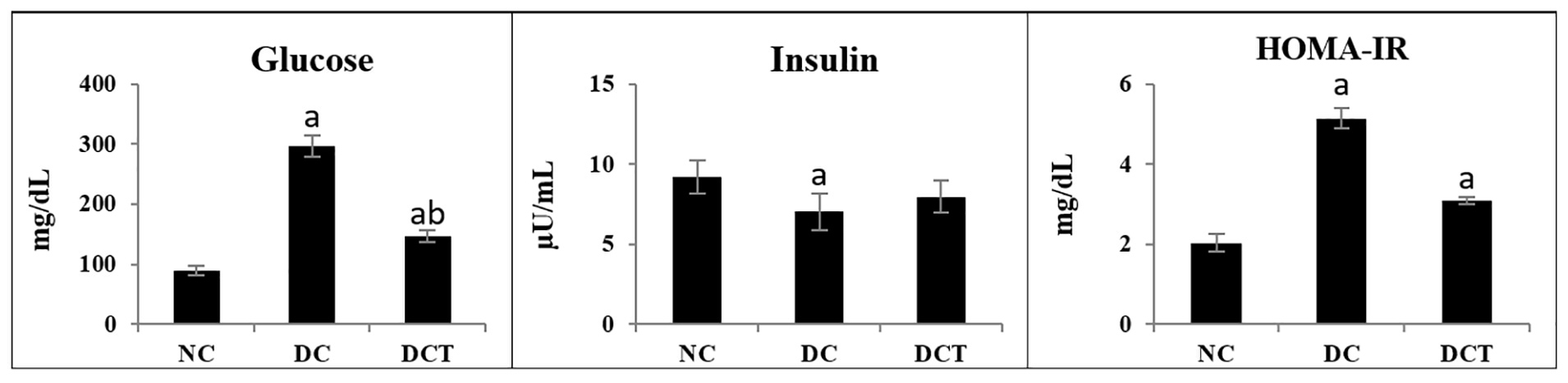
Figure 1.The chart displays the effects of type 2 diabetes and exercise on fasting blood insulin, glucose and homeostatic Model Assessment for Insulin Resistance (HOMA-IR). Data expressed as mean±SD. NC: Normal control; DC: Diabetes control; DCT: Diabetes+combined training; aIntergroup significant difference versus the NC group; bVersus the DC group
NLRP3/Caspase-1, Pro-Caspase-1 Protein Expression, and IL1β Elisa Levels
Protein densitometry analysis of heart tissue showed that diabetes induction increased the protein levels of NLRP3 (P=0.017), cleaved-caspase-1 (P<0.001), and also ELISA levels of IL-1β (P<0.001) in the DC group compared to the NC group; and Pro-casp1 (P<0.001) decreased compared to the NC group. Combined training was able to modulate NLRP3 (P=0.03), Pro-casp1 (P=0.002), cleaved-caspase-1 (P<0.001), and IL-1β (P=0.019) in comparison to the DC group. Additionally, combined training by reducing the conversion of pro-caspase-1 to cleaved-caspase-1 caused an increase in pro-caspase-1 (P=0.002) compared to the DC group (figure 2).
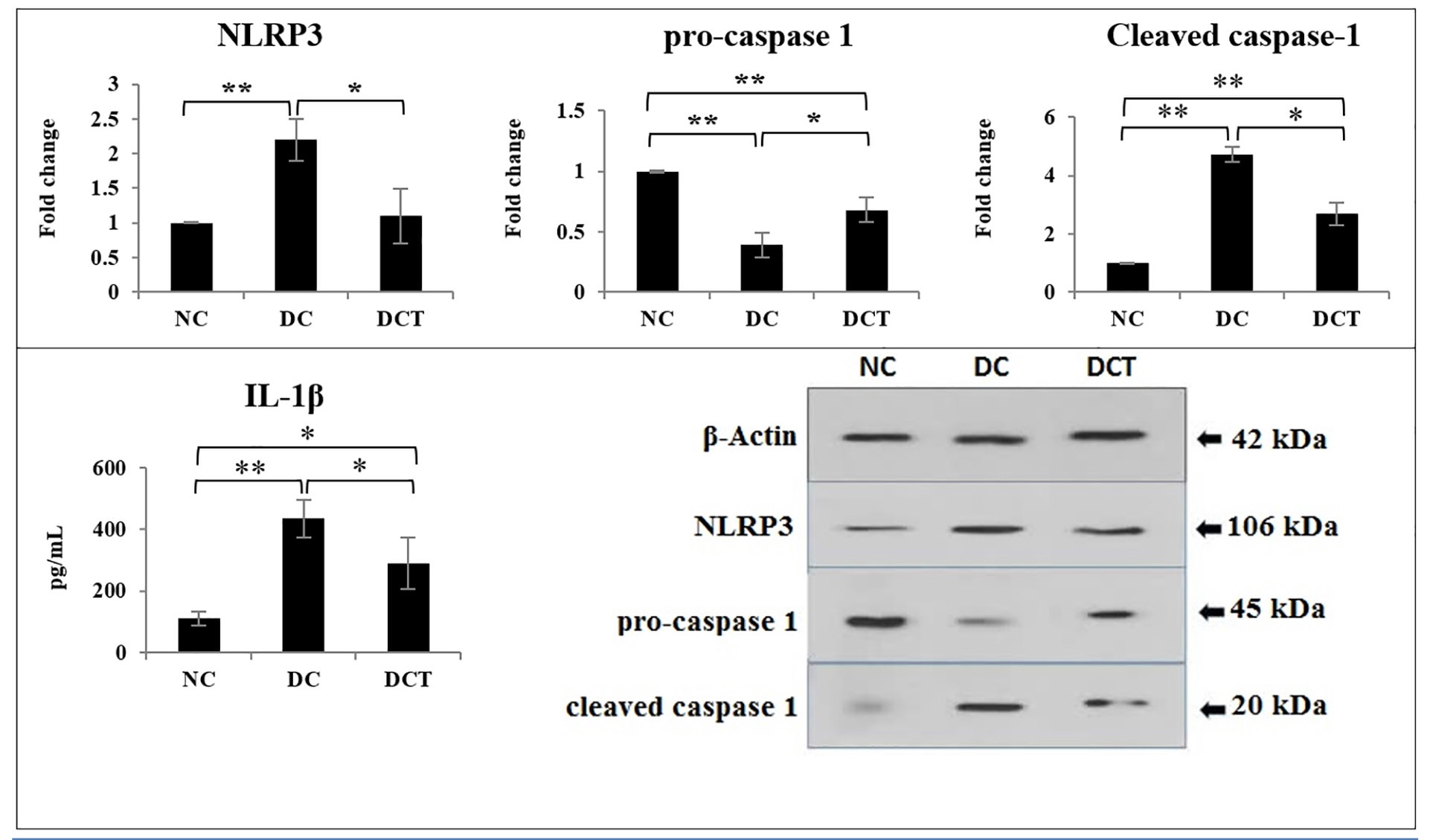
Figure 2.The chart displays the effects of type 2 diabetes and exercise on nucleotide-binding domain, leucine-rich–containing family, pyrin domain–containing-3 (NLRP3), pro-caspase-1, cleaved-caspase-1, and an ELISA plot of interleukin-1β. Data are shown as mean±SEM; *Significant group difference at P<0.05 and **at P<0.01. NC: Normal control; DC: Diabetes control; DCT: Diabetes+combined training
Discussion
To our knowledge, this is the first study that investigates the synergistic effects of combined aerobic and resistance exercise on the modulation of downstream cytokines (interleukin-1β/caspase-1) and insulin resistance in diabetic rats. The novel findings of the present investigation demonstrate that type 2 diabetes elevates the levels of NLRP3, cleaved caspase-1, and interleukin-1 beta in cardiac tissue. The major effects of combined training were through reduced serum glucose levels and improved insulin sensitivity, finally interpreted as modulated insulin resistance. The reduction in cleaved caspase-1 through combined training led to an increase in pro-caspase-1, suggesting diminished activation of the NLRP3 inflammasome and decreased production of active caspase-1.
Type 2 Diabetes Mellitus (T2DM) is linked to elevated blood glucose levels and insulin resistance.21 This study demonstrates that type 2 diabetes leads to increased insulin resistance, a characteristic of T2DM, due to elevated blood glucose levels and suppression of serum insulin. This indicates that streptozotocin (STZ) -induced damage results from the disruption of pancreatic β-cell function. In a rat model of T2DM induced by STZ and nicotinamide, insulin levels demonstrate time-dependent variations, initially presenting as hyperglycemia with partial insulin deficiency. During this phase, STZ induces partial β-cell destruction, whereas nicotinamide protects some β-cells, resulting in moderate insulin deficiency. Transient hyperglycemia resulting from STZ toxicity and reduced insulin secretion due to β-cell damage are two primary indicators of this stage. In the initial phase of T2DM induction, nicotinamide administration leads to hypersecretion (hyperinsulinemia) from surviving β-cells and facilitates pancreatic recovery. Over weeks to months, late-stage β-cell dysfunction occurs as insulin levels decline due to gradual β-cell failure and chronic hyperglycemia, a phenomenon consistent with our results. In the early stage of T2DM induction via STZ injection, rats may exhibit transient weight loss attributed to metabolic instability. Further weight gain may occur because nicotinamide partially protects β-cells from apoptosis, leading to the development of insulin resistance (IR), which subsequently results in hyperinsulinemia and increased fat deposition, interpreted as weight gain.22 In parallel, a 15% and 30% weight gain was observed in the DC and NC groups, respectively, compared to baseline. Combined training resulted in a 20% weight gain, primarily attributed to a reduction in fat mass, an increase in lean mass, and enhanced insulin sensitivity, which facilitated improved glucose utilisation rather than fat storage.
Endothelial dysfunction has been demonstrated to significantly reduce nitric oxide secretion from endothelial cells, which is a key factor in the development of insulin resistance. This occurs because insulin, through its nitric oxide-dependent mechanism, facilitates glucose uptake in skeletal muscle. Combined exercise employing various mechanisms of action modulates insulin resistance. Specifically, resistance exercise utilising a shear stress mechanism activates the enzyme eNOS, enhancing endothelial function. This improvement subsequently reduces vascular inflammatory factors, such as iNOS, associated with the induction of insulin resistance. The elevation of iNOS resulting from insulin resistance in the bloodstream leads to a downregulation of the insulin receptor, including IRS1 and IRS2, thereby inhibiting insulin binding to its receptor. Previous research has indicated a direct correlation between circulating iNOS levels and heightened fat accumulation. Aerobic exercise operates through three mechanisms: (1) enhancing the activity of enzymes that facilitate lipolysis, (2) elevating leptin levels, which promotes satiety and reduces appetite, and (3) boosting basal metabolic energy levels, thereby activating hormone-sensitive lipase (HSL) and the beta subunit of the AMPK peptide. This activation increases lipid participation in metabolic processes and improves body composition.23 According to Stanford and Goodyear, endurance exercise enhances skeletal muscle mitochondrial content, GLUT4 protein expression, glucose absorption, and insulin sensitivity.23 A review study examining the impact of exercise on fasting blood glucose levels revealed that, among five studies, only one indicated a significant reduction in fasting blood glucose levels as a result of exercise. In four additional studies, although the fasting blood glucose levels in the exercise intervention group decreased, this change was not statistically significant.2 The current research indicated that the decrease in blood glucose resulting from combined training was not statistically significant. Insulin resistance is associated with inflammation and increases the incidence of cardiovascular disease in diabetic patients. Exercise enhances insulin resistance through increased glucose uptake and consumption rates, while also reducing TNF-α levels.24 Exercise enhances insulin resistance by modulating the insulin action pathway via ASK1.25 The results of this study indicated that combined training significantly decreased insulin resistance compared to diabetes.
Glucose serves as a significant activator of the NLRP3 inflammasome.26 Elevated ROS production resulting from high glucose levels can influence NF-kB phosphorylation and TXNIP expression, thereby facilitating NLRP3 inflammasome activation.3 The elevation of P2X7R due to high glucose concentrations enhances the activation of the NLRP3 inflammasome.27 Research indicates that diabetic DCM correlates with the activation of the NLRP3 inflammasome.7 A study indicated that inactivation of the NLRP3 gene after 8 weeks in diabetic rats reduced the incidence of diabetic cardiomyopathy in type 2 diabetes mouse models.28 Targeting the NLRP3 inflammasome pathway, given its involvement in diabetic cardiomyopathy (DCM), may effectively reduce the risk of cardiac failure in diabetes. Given the critical function of the NLRP3 inflammasome in the progression of DCM, research has been undertaken to examine the impact of drug administration on this protein. The regulation of the NLRP3 inflammasome facilitates this process. A study demonstrated that inhibiting NLRP3 and MAPK inflammasome pathways in a type 2 diabetic mouse model by rosuvastatin resulted in DCM reduction.28 Dapagliflozin-mediated inhibition of SGLT-2 has been demonstrated to decrease ASC/NLRP3 inflammasome activation and mitigate DCM in rats with type 2 diabetes after an 8-week period.29 Gypenosides enhance DCM by inhibiting the activation of the NLRP3 inflammasome mediated by ROS.30 Research indicates that type 2 diabetes activates the NLRP3 inflammasome via multiple pathways, such as elevated blood glucose levels and increased production of reactive oxygen species (ROS). This study found that type 2 diabetes elevated the levels of NLRP3, caspase-1, and interleukin(IL)-1β proteins in the cardiac tissue of rats.
Exercise is a recommended intervention for DCM, as it prevents cardiac inflammation, reverses structural changes in the heart, and restores cardiac function.3 Exercise influences the signalling pathway of the NLRP3 complex. Numerous studies examine the impact of endurance training.31 There is a paucity of research investigating the impact of combined endurance and resistance training on the signalling pathway of the NLRP3 complex. Zaidi and colleagues demonstrated that a year of combined endurance and resistance training does not affect the activity of the NLRP3 inflammasome in serum leukocytes and adipose tissue of adults with T2DM and coronary artery disease.32 The research was limited by the subjects’ use of platelet inhibitors and anti-diabetic medications, which likely influenced inflammatory factors and obscured the potential effects of exercise training. Quiroga and colleagues examined the impact of 12 weeks of combined endurance and resistance training on NLRP3 inflammasome activation, revealing a significant reduction in NLRP3 activity in peripheral blood mononuclear cells (PBMC) of obese children.12 The current study observed that the elevation of NLRP3 protein in the cardiac tissue of rats with type 2 diabetes was mitigated by combined training. Inhibiting NLRP3 diminishes the activation of the NLRP3 inflammasome signalling pathway.28 Inhibition of the NLRP3 inflammasome activity led to the suppression of caspase-1 and the conversion of pro-IL-1β to its active form.7 Our findings demonstrated that combined training mitigated the elevation of caspase-1 and IL-1β proteins induced by diabetes in the cardiac tissue of rats.
In line with our findings, Lee and colleagues33 demonstrated that the elevation of NLRP3, caspase-1, and IL-1β in the myocardium of obese rats subjected to a high-fat diet was significantly reduced following 12-14 weeks of voluntary running. A separate study demonstrated that a high-fat diet elevated cardiac expression levels of P2X7R, NLRP3, caspase-1, and serum IL-1β in rats. Twelve weeks of treadmill running (from 5 m/min to 10 m/min, 1 hour/day, 7 days/week) significantly enhanced collagen deposition and reduced cellular disruption while inhibiting the expression of NLRP3, caspase-1, P2X7R, and IL-1β in rat myocardium.10 Kar and colleagues demonstrated that a high-fat diet induces the formation and activation of the NLRP3 inflammasome in the left ventricle of rats. Furthermore, a regimen of 20 weeks of treadmill exercise (5 days per week at a speed of 12-15 m/min for 50 min) mitigated the regulation of NLRP3, ASC, pro-caspase-1, and IL-1β associated with the high-fat diet and the activation of caspase-1.33 The present study differs from the aforementioned studies in terms of the intervention aimed at increasing proteins in the NLRP3 complex pathway, the training protocol employed, and the duration of the protocol. However, the results are consistent and indicate that exercise influences the activity of the NLRP3 inflammasome pathway in cardiac tissue. Endurance exercise diminishes the activity of TXNIP/NLRP3 inflammasomes through a reduction in the expression of endoplasmic reticulum stress proteins.34 The aforementioned studies indicate that 12-20 weeks of endurance exercise can decrease NLRP3, caspase-1, and IL-1β proteins in cardiac tissue. However, our study demonstrated that a shorter duration of 8 weeks of combined endurance-resistance training also lowers these proteins in the cardiac tissue of diabetic male rats.
The research conducted by Ma and colleagues demonstrated that an 8-week protocol of aerobic exercise (treadmill at 12 to 15 m/min, 1 hour daily, 5 days weekly) regulates mitochondrial quality and alleviates endoplasmic reticulum stress, thereby improving cardiac hypertrophy via M2 AChR. Additionally, it reduces the expression of NLRP3, caspase-1, and IL-1β proteins in myocardial cells of rats with myocardial hypertrophy.35 Resistance training (stair climbing, 3 times daily for 1 min each interval, 5 days a week for 10 weeks) has been found to have effects comparable to those of endurance training (treadmill training at 80% VO2 max for 30 min daily, 5 days a week for 10 weeks) in reducing NLRP3 mRNA expression in the adipose tissue of rats on a high-fat diet.11 This demonstrates the efficacy of endurance and resistance training in reducing NLRP3 inflammasome activity. Research on the effects of resistance training remains limited. The current study demonstrates that integrating endurance and resistance training reduces NLRP3 inflammasome activity. The mechanisms by which exercise attenuates NLRP3 inflammasome activation remain incompletely understood. Previous research indicates that aerobic exercise likely reduces oxidative stress,35 endoplasmic reticulum stress,34 and P2X7R,10 while also regulating mitochondrial biogenesis quality. This regulation plays a significant role in modulating the NLRP3 inflammasome and mitigating cardiac risks associated with diabetes. Additional research in this domain will enhance our comprehension of the fundamental relationships among exercise, inflammation, and DCM.
A major limitation of this study is the lack of direct measurements of histological assessments and/or oxidative stress markers. It is suggested that future studies investigate the effects of exercise on upstream proteins associated with this signaling pathway, in addition to the effects of short-term and long-term exercise on these factors in the cardiac tissue of diabetic patients.
Conclusion
According to the results, it seems that the adverse effect of type 2 diabetes on the increase of NLRP3, caspase-1, and IL-1β proteins in cardiac tissue can be modulated or downregulated by combined training (endurance+resistance). Considering the relationship between the NLRP3 inflammasome signaling pathway and DCM, it can be concluded that combined endurance-resistance training is effective in reducing the key factors in the development of DCM. Furthermore, it can be postulated that the NLRP-3 inflammasome serves as an oxidative stress biomarker that becomes elevated during metaflammation, thereby representing a potential therapeutic target in the prevention and treatment of metabolic syndrome.
Acknowledgment
We hereby sincerely thank and appreciate all the assistants who have cooperated in the progression of this study. This study was extracted from the Ph.D thesis of Kambiz Pourfarzad. No funding was received for this study.
Authors’ Contribution
K.PF: Data collection and interpretation, drafting and reviewing the manuscript; R.S: Study design, data analysis, drafting and reviewing the manuscript; N.H and S.R: Data analysis and interpretation, drafting and reviewing the manuscript; All authors contributed to the study’s conception and design and commented on the last versions of the manuscript and read and approved the final manuscript and provided an agreement to be accountable for all aspects of the work in ensuring that questions related to the accuracy or integrity of any part of the work are appropriately investigated and resolved.
Declaration of AI
We confirm that no artificial intelligence (AI) tools, including large language models (LLMs), chatbots, or image generators, were used at any stage of the research design, data collection, data analysis, or manuscript preparation.
Conflict of Interest
None declared.
References
- Amanat S, Ghahri S, Dianatinasab A, Fararouei M, Dianatinasab M. Exercise and Type 2 Diabetes. Adv Exp Med Biol. 2020; 1228:91-105. DOI | PubMed
- Sampath Kumar A, Maiya AG, Shastry BA, Vaishali K, Ravishankar N, Hazari A. Exercise and insulin resistance in type 2 diabetes mellitus: A systematic review and meta-analysis. Ann Phys Rehabil Med. 2019; 62:98-103. DOI | PubMed
- Sun Y, Ding S. NLRP3 Inflammasome in Diabetic Cardiomyopathy and Exercise Intervention. Int J Mol Sci. 2021; 22Publisher Full Text | DOI | PubMed [ PMC Free Article ]
- Yu ZW, Zhang J, Li X, Wang Y, Fu YH, Gao XY. A new research hot spot: The role of NLRP3 inflammasome activation, a key step in pyroptosis, in diabetes and diabetic complications. Life Sci. 2020; 240:117138. DOI | PubMed
- Satheesan A, Kumar J, Leela KV, Murugesan R, Chaithanya V, Angelin M. Review on the role of nucleotide-binding oligomerization domain-like receptor protein 3 (NLRP3) inflammasome pathway in diabetes: mechanistic insights and therapeutic implications. Inflammopharmacology. 2024; 32:2753-79. DOI | PubMed
- Swanson KV, Deng M, Ting JP. The NLRP3 inflammasome: molecular activation and regulation to therapeutics. Nat Rev Immunol. 2019; 19:477-89. Publisher Full Text | DOI | PubMed [ PMC Free Article ]
- Luo B, Huang F, Liu Y, Liang Y, Wei Z, Ke H. NLRP3 Inflammasome as a Molecular Marker in Diabetic Cardiomyopathy. Front Physiol. 2017; 8:519. Publisher Full Text | DOI | PubMed [ PMC Free Article ]
- Milan KL, Megha B, Ramkumar KM. Role of inflammasomes in diabetes mellitus: mechanisms, complications, and therapeutic potential. Mol Biol Rep. 2025; 52:621. DOI | PubMed
- Schroeder EC, Franke WD, Sharp RL, Lee DC. Comparative effectiveness of aerobic, resistance, and combined training on cardiovascular disease risk factors: A randomized controlled trial. PLoS One. 2019; 14:e0210292. Publisher Full Text | DOI | PubMed [ PMC Free Article ]
- Chen X, Li H, Wang K, Liang X, Wang W, Hu X. Aerobic Exercise Ameliorates Myocardial Inflammation, Fibrosis and Apoptosis in High-Fat-Diet Rats by Inhibiting P2X7 Purinergic Receptors. Front Physiol. 2019; 10:1286. Publisher Full Text | DOI | PubMed [ PMC Free Article ]
- Mardare C, Kruger K, Liebisch G, Seimetz M, Couturier A, Ringseis R. Endurance and Resistance Training Affect High Fat Diet-Induced Increase of Ceramides, Inflammasome Expression, and Systemic Inflammation in Mice. J Diabetes Res. 2016; 2016:4536470. Publisher Full Text | DOI | PubMed [ PMC Free Article ]
- Quiroga R, Nistal E, Estebanez B, Porras D, Juarez-Fernandez M, Martinez-Florez S. Exercise training modulates the gut microbiota profile and impairs inflammatory signaling pathways in obese children. Exp Mol Med. 2020; 52:1048-61. Publisher Full Text | DOI | PubMed [ PMC Free Article ]
- Liang F, Huang T, Li B, Zhao Y, Zhang X, Xu B. High-intensity interval training and moderate-intensity continuous training alleviate beta-amyloid deposition by inhibiting NLRP3 inflammasome activation in APPswe/PS1dE9 mice. Neuroreport. 2020; 31:425-32. DOI | PubMed
- ZhuGe DL, Javaid HMA, Sahar NE, Zhao YZ, Huh JY. Fibroblast growth factor 2 exacerbates inflammation in adipocytes through NLRP3 inflammasome activation. Arch Pharm Res. 2020; 43:1311-24. DOI | PubMed
- Guide for the Care and Use of Laboratory Animals. The National Academies Collection: Reports funded by National Institutes of Health. Washington (DC); 2011. DOI | PubMed
- Rashidpour A, Piralaiy E, Hamidian G, Ismael BR. Protective effects of aerobic exercise on cardiac histology and stereological parameters in a rat model of type 2 diabetes mellitus. J Diabetes Metab Disord. 2025; 24:138. Publisher Full Text | DOI | PubMed [ PMC Free Article ]
- Shaikh SA, Varatharajan R, Muthuraman A. Palm Oil Derived Tocotrienol-Rich Fraction Attenuates Vascular Dementia in Type 2 Diabetic Rats. Int J Mol Sci. 2022; 23Publisher Full Text | DOI | PubMed [ PMC Free Article ]
- Parastesh M, Heidarianpour A, Sadegh M. Investigating the effects of endurance, resistance and combined training on reproductive hormones and sperm parameters of streptozotocin-nicotinamide diabetic male rats. J Diabetes Metab Disord. 2019; 18:273-9. Publisher Full Text | DOI | PubMed [ PMC Free Article ]
- Ghadiri N, Gorgin Karaji Z, Farsani ZH, Akbarzadeh H. The combined effects of resistance and endurance training with ursolic acid supplementation on some Alzheimer’s disease-related biomarkers in a rat model of type 2 diabetes. Bulletin of the National Research Centre. 2024; 48:85. DOI
- Galvan-Alvarez V, Martin-Rincon M, Gallego-Selles A, Martinez Canton M, HamedChaman N, Gelabert-Rebato M. Determinants of the maximal functional reserve during repeated supramaximal exercise by humans: The roles of Nrf2/Keap1, antioxidant proteins, muscle phenotype and oxygenation. Redox Biol. 2023; 66:102859. Publisher Full Text | DOI | PubMed [ PMC Free Article ]
- Chen D, Sindone A, Huang MLH, Peter K, Jenkins AJ. Diabetic cardiomyopathy: insights into pathophysiology, diagnosis and clinical management. J Mol Cell Cardiol. 2025; 206:55-69. DOI | PubMed
- Rais N, Ved A, Ahmad R, Parveen K, Gautam GK, Bari DG. Model of Streptozotocin-nicotinamide Induced Type 2 Diabetes: a Comparative Review. Curr Diabetes Rev. 2022; 18:e171121198001. DOI | PubMed
- Stanford KI, Goodyear LJ. Exercise and type 2 diabetes: molecular mechanisms regulating glucose uptake in skeletal muscle. Adv Physiol Educ. 2014; 38:308-14. Publisher Full Text | DOI | PubMed [ PMC Free Article ]
- Petersen AM, Pedersen BK. The anti-inflammatory effect of exercise. J Appl Physiol (1985). 2005; 98:1154-62. DOI | PubMed
- Zhang Y, Ye T, Zhou P, Li R, Liu Z, Xie J. Exercise ameliorates insulin resistance and improves ASK1-mediated insulin signalling in obese rats. J Cell Mol Med. 2021; 25:10930-8. Publisher Full Text | DOI | PubMed [ PMC Free Article ]
- Ding S, Xu S, Ma Y, Liu G, Jang H, Fang J. Modulatory Mechanisms of the NLRP3 Inflammasomes in Diabetes. Biomolecules. 2019; 9Publisher Full Text | DOI | PubMed [ PMC Free Article ]
- Zhang X, Fu Y, Li H, Shen L, Chang Q, Pan L. H3 relaxin inhibits the collagen synthesis via ROS- and P2X7R-mediated NLRP3 inflammasome activation in cardiac fibroblasts under high glucose. J Cell Mol Med. 2018; 22:1816-25. Publisher Full Text | DOI | PubMed [ PMC Free Article ]
- Luo B, Li B, Wang W, Liu X, Liu X, Xia Y. Rosuvastatin alleviates diabetic cardiomyopathy by inhibiting NLRP3 inflammasome and MAPK pathways in a type 2 diabetes rat model. Cardiovasc Drugs Ther. 2014; 28:33-43. DOI | PubMed
- Ye Y, Bajaj M, Yang HC, Perez-Polo JR, Birnbaum Y. SGLT-2 Inhibition with Dapagliflozin Reduces the Activation of the Nlrp3/ASC Inflammasome and Attenuates the Development of Diabetic Cardiomyopathy in Mice with Type 2 Diabetes. Further Augmentation of the Effects with Saxagliptin, a DPP4 Inhibitor. Cardiovasc Drugs Ther. 2017; 31:119-32. DOI | PubMed
- Zhang H, Chen X, Zong B, Yuan H, Wang Z, Wei Y. Gypenosides improve diabetic cardiomyopathy by inhibiting ROS-mediated NLRP3 inflammasome activation. J Cell Mol Med. 2018; 22:4437-48. Publisher Full Text | DOI | PubMed [ PMC Free Article ]
- Zhang T, Ding S, Wang R. Research Progress of Mitochondrial Mechanism in NLRP3 Inflammasome Activation and Exercise Regulation of NLRP3 Inflammasome. Int J Mol Sci. 2021; 22Publisher Full Text | DOI | PubMed [ PMC Free Article ]
- Zaidi H, Byrkjeland R, Njerve IU, Akra S, Solheim S, Arnesen H. Effects of exercise training on inflammasome-related mediators and their associations to glucometabolic variables in patients with combined coronary artery disease and type 2 diabetes mellitus: Sub-study of a randomized control trial. Diab Vasc Dis Res. 2019; 16:360-8. DOI | PubMed
- Lee J, Lee Y, LaVoy EC, Umetani M, Hong J, Park Y. Physical activity protects NLRP3 inflammasome-associated coronary vascular dysfunction in obese mice. Physiol Rep. 2018; 6:e13738. Publisher Full Text | DOI | PubMed [ PMC Free Article ]
- Hong J, Park E, Lee J, Lee Y, Rooney BV, Park Y. Exercise training mitigates ER stress and UCP2 deficiency-associated coronary vascular dysfunction in atherosclerosis. Sci Rep. 2021; 11:15449. Publisher Full Text | DOI | PubMed [ PMC Free Article ]
- Ma M, Chen W, Hua Y, Jia H, Song Y, Wang Y. Aerobic exercise ameliorates cardiac hypertrophy by regulating mitochondrial quality control and endoplasmic reticulum stress through M(2) AChR. J Cell Physiol. 2021; 236:6581-96. DOI | PubMed


